
We all meet people whose behaviour hurts us. They may lie, gossip, manipulate, or speak harshly. We may try to reason with them, confront them, or simply keep our distance.
But sometimes their behaviour begins to affect us. Their anger becomes our anger. Their bitterness becomes our bitterness. Without realizing it, we begin to change in ways we never intended.
An old story about a sage and a scorpion offers a timeless reminder.
The sage by the river

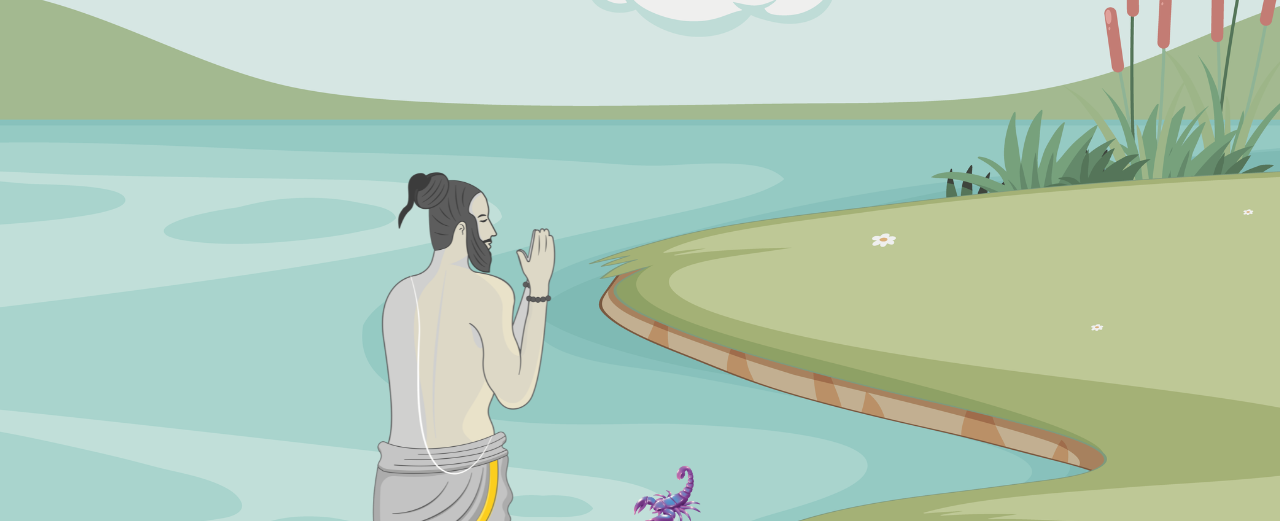
One day, a sage went to a river to bathe. As he stepped into the water, he noticed a scorpion struggling to stay afloat.
The sage reached down to lift it out of the water. The moment he touched it, the frightened scorpion stung him. Startled by the pain, the sage withdrew his hand, and the scorpion fell back into the river.
After a moment, the sage composed himself and tried again. Once more, the scorpion stung him. Again and again, the same thing happened.
Finally, using great care, the sage was able to lift the scorpion and place it safely on the riverbank.
The observer’s question
Another man had been watching the whole scene from a distance. Unable to understand what he had witnessed, he approached the sage and asked,
“Why do you keep trying to save it? It keeps stinging you. It will never change.”
The sage smiled and replied,
“It is the nature of the scorpion to sting. It does not understand that I am trying to save it. It is afraid, panics and stings to protect itself. It does not forget its nature. It is my nature to have compassion for others. If a small creature does not forget its nature, why should I forget mine?”

The deeper lesson

We face the same dilemma in everyday life. Someone repeatedly behaves with anger, gossip, manipulation or dishonesty. We feel hurt. We react. Soon, we conclude that such people do not deserve our kindness.
Yet the story is asking us to look somewhere else.
The real question is not whether the other person deserves compassion.
The real question is whether we will allow another person’s behaviour to decide who we become.
As BK Sister Shivani often reminds us, our original nature is peace, compassion, cooperation and courage. When we remain centred in these qualities, we experience inner stability. But when we allow another person’s behaviour to pull us into anger, resentment or bitterness, we lose that centre. We step off our own inner throne.
This does not mean accepting harmful behaviour or failing to set healthy boundaries. We may still need to speak firmly, say “no”, or walk away from an unhealthy situation. But we can do all this without giving away our own peace.

Seeing beneath behaviour
Thich Nhat Hanh offers another perspective:

“When another person makes you suffer, it is because he suffers deeply within himself, and his suffering is spilling over. He does not need punishment; he needs help.”
Elsewhere, he reminds us that every person carries seeds of both joy and suffering, planted by family, ancestors and society. When we understand this, compassion becomes easier. We no longer see only the behaviour; we begin to see the suffering beneath it.
“With understanding and love, we will know how to water our own beautiful seeds and those of others, and we will recognize seeds of suffering and find ways to transform them.”
Growing into our higher nature
Remaining peaceful in difficult situations is not easy. BK Sister Shivani suggests that we grow into it gradually.
If today you react with anger, let your first step simply be this: say what needs to be said, but without anger. Speak clearly, then let the matter rest.
Do not spend the rest of the day replaying the incident in your mind. Remember that your wellbeing does not depend on another person’s behaviour. And if you can, remind yourself that people often hurt others because they themselves are hurting.
Even if you reacted poorly this time, do not lose heart. Later, quietly rehearse the response you wish you had given. The next time, it will come a little more naturally.
Little by little, we stop reacting to who others are being, and begin responding from who we want to be.

Returning darkness with darkness only deepens the darkness for both people. But when we remain rooted in peace, courage and compassion, we protect something far more valuable than winning an argument—we protect our own nature.
Perhaps that is the deepest lesson of the sage and the scorpion.
Reflection question
What helps you remain calm when someone behaves negatively?
Leave a Reply