
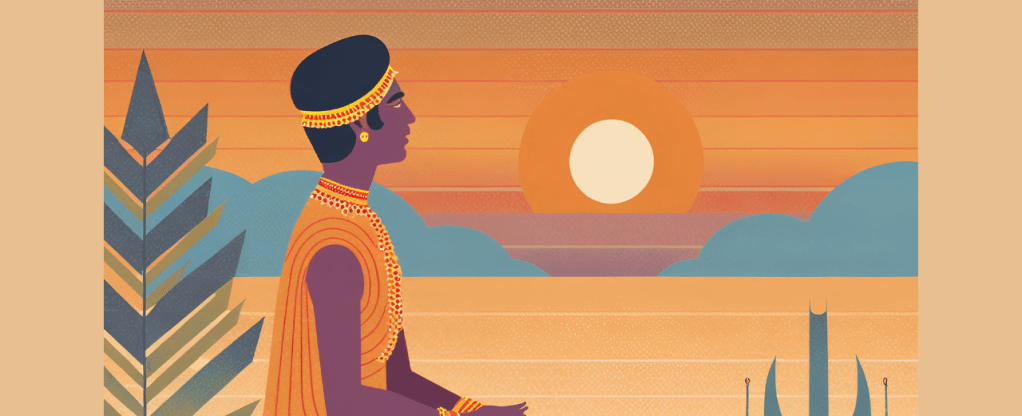
There is a story about a prince who loses his memory and wanders far from his kingdom. He stumbles upon a group of beggars who welcome him as one of their own. Each morning, they leave for town to beg from door to door. When they return, they share their alms with the prince, who eagerly awaits their arrival. Every day, upon seeing them from afar, he runs up to them and takes something from each of their bowls.
Meanwhile, the king and queen have sent messengers throughout the land and to neighboring regions in search of their son. One day, the messengers find the prince. Overjoyed, they remind him of his true identity and the life he left behind. Slowly, the prince remembers who he really is and prepares to return to his kingdom. Before leaving, he turns to his beggar friends and asks, “Can you recall where you came from? What if you too are lost princes and have simply forgotten who you are?”
This story reflects the journey of our mind. Our mind has forgotten that it is a creation of the Divine Light, and that same Light resides within us. With this awareness, we recognize that the mind has tremendous power and infinite creative potential. Like the prince, it is meant to give, not to ask.
Seeking from others
It’s a paradox of modern life that while we work hard to achieve financial independence, we often overlook the emotional dependence we carry—seeking validation, love, and security from people, accomplishments, or external circumstances. BK Sister Shivani, a Rajyoga meditation teacher, explains this concept beautifully in one of her talks on emotional resilience:
While we take pride in being financially independent, emotionally, we go around as beggars. With both hands stretched out, we forever look to others with expectation—give me respect, give me security, give me love… do things my way so that I am happy.
BK Sister Shivani
When our expectations aren’t met, we lose our peace. We believe that unless others change, we cannot be happy. Since people can’t always meet our expectations, our happiness fluctuates, creating a rollercoaster of emotions. This constant cycle of highs and lows drains our energy and potential.
The way out is in
Wisdom traditions remind us that true happiness and peace lie within us, not outside. When we remember that our real self is born from the Infinite, we will discover our hidden reservoir of strength and power. And when we learn to tap into this reservoir within, we discover that our true nature is to give, not to seek. The more we give as channels of the Universe, the more abundance flows through us.
In his book Dharam Kala, Jaswant Singh Parwana beautifully explains how the same inner power can take the form of ‘Moha’ (Desire/Want) or ‘Prem’ (Offering/Love). Moha is a flight toward the world of materials, while Prem is a flight toward the source of life. Moha finds joy in acquiring, while Prem finds joy in offering.
In the Mahabharata, Vidura embodies ‘Prem’. He may have offered saltless spinach to Bhagavan Krishna, but he offered something, asking for nothing in return. Similarly, despite his material poverty, Sudama offered to Krishna whatever he could – even if it were a fistful of puffed rice. In contrast, when consumed by ‘Moha’, a person may possess a lot of wealth, yet still desire more. When Krishna visited Duryodhana to dissuade him from war, Duryodhana refused to yield even a needlepoint of land. Given a choice between Krishna himself and his vast army, he chooses Krishna’s army. Those who live in ‘Prem’, like Sabari, might present only four berries to Sri Ram, but find joy in giving, not asking.
What We Seek, We Become
Why does it matter to live from a place of love? Because what we seek, we gravitate toward. Living in ‘want’ ties us down to the material world, and with every acquisition, the sense of emptiness grows. This sets off an endless cycle of wanting more. By turning toward the light within, we tap into a reservoir of love and discover we have infinite blessings to offer to the world. We learn to flow with life, allowing the Infinite to flow through us—like a wave content to lose itself in the ocean.
References
- Talks on Rajyoga meditation by Sister Shivani
- Dharam Kala by Jaswant Singh Parwana
Reflection question
What helps you reconnect with your ‘real self’ when faced with a challenging situation or doubt?


 The Sabad Project - Wisdom stories
Leave a reply to Arun Cancel reply