
There are habits that can be changed with effort, and there are habits that seem to take hold of us. We may know they harm us, yet still return to them. Some patterns become so strong that they begin to shape the direction of our lives.

At such times, despair can quietly arise:
I have tried before.
Nothing changes.
I have gone too far down this road.
There is no way back for me now.
Here is a story from the Bhagavata Purana that speaks to this reality of life — and to the door of hope that still remains open.
The Story of Ajamila
In the city of Kanauj lived Ajamila, the son of the head priest. He was bright, learned in the scriptures, gentle by nature, disciplined, and truthful.
His teacher had cautioned him to avoid a certain part of the town, known for vice and excess.
One day, Ajamila went to the forest to gather fruits, flowers, sticks for the sacred fire, and Kuśa grass for a ritual. On his way home, he chose to take the route through the prohibited area. He had been warned, but curiosity got the better of him. There he encountered a prostitute, and dormant tendencies within him were awakened.


Though he possessed learning and wisdom, he gave in to temptation. What began as a moment of weakness slowly became a way of life.
He left his family and went to live with the woman. To support that life, he turned to gambling and theft. Years passed, and they had ten children.
When a Person Sees No Way Back
One day, some wandering sadhus came by, and the couple offered them food. One among them saw their condition and understood the sorrow beneath it.
Ajamila spoke with regret:
I have gone so far down this path that I no longer see a way back.
The sadhu sensed that Ajamila’s life was nearing its end. He said with compassion:
“You are soon to have another child. Name him Narayana. Raise him with love. All will be well.”

The Young Child

Ajamila did as advised. He grew very fond of the child. He lovingly followed him around the house, feeding him and delighting in his playful ways.
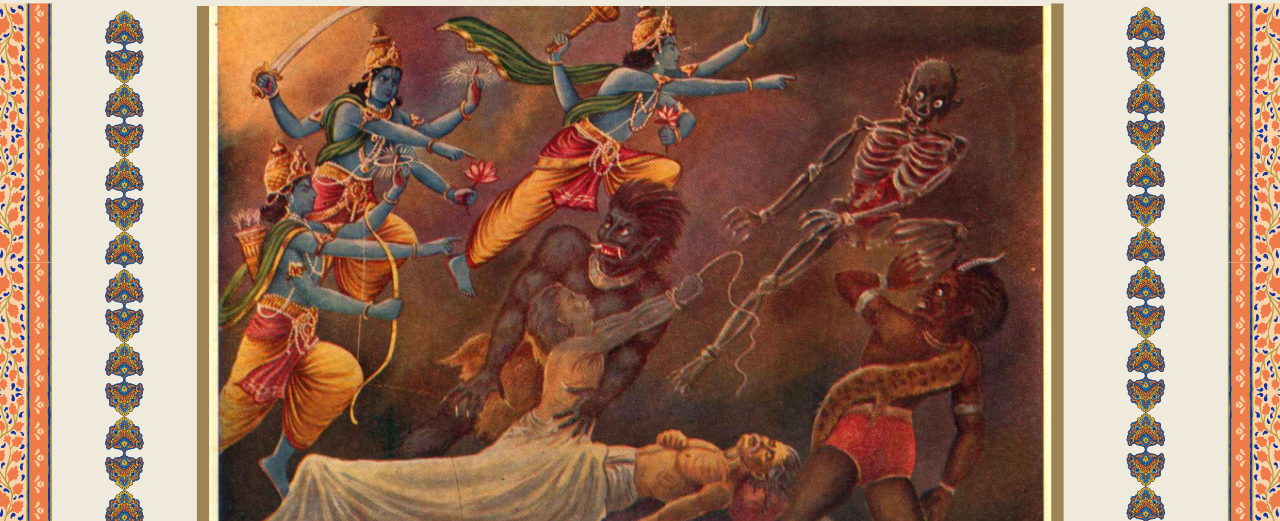
One day, Ajamila fell gravely ill. He saw the messengers of death hovering around him, and they appeared terrifying. In fear, he began calling out to his son:
“Narayana! Narayana! Please come and help me!”
The child was at some distance, absorbed in his playthings. Ajamila continued to cry out:
“Narayana! Save me, Narayana!”
Though he had first called only for his son, through repeated calling his heart now turned toward Narayana—the Divine, a Name he had meditated upon in past lives.
The messengers of Narayana heard his cry and rushed to protect him from the messengers of Yama.
The messengers protested:
“Who are you, and why do you stop us? The past actions of this man have been accounted for, and he is due for punishment.”

Deciding the Fate of Ajamila

A long dialogue followed. At last, the angels convinced the messengers of Dharma Raja.
They said that when an ignorant animal falls asleep in the lap of its master, it rests in innocent trust that the master will care for it. In the same way, though this man has committed many actions in ignorance, by calling out to Narayana he has sought refuge.
Even if he first called the name of his son, it was also the Name of the Divine.
The Wisdom for Our Lives
Some habits are stronger than willpower alone. Effort, discipline, and wisdom matter. But there are times when a person also needs refuge – something greater than the force pulling them down.
Aniruddha Bapu points to an experience many people know well. Even after years of meditation, prayer, or spiritual practice, the mind continues to wander. The anger, envy, or anxiety we are trying to work through still rises within us – even while we meditate. Despite sincere resolutions to change our habits, mental patterns, or ways of relating to others, old tendencies often persist. Does this mean nothing is happening?

He offers a striking example:

“Whether a person takes poison knowingly, unknowingly, or is made to consume it, it still has the same effect on the body. If poison is so potent, will not the Name of the Divine – the nectar of life – have far greater power? Whether we chant in ignorance or in awareness, it still carries its transforming power.”
He urges: Keep up your practice. Even when the habit seems to have taken you in its grip, keep chanting – like a child calling out to its mother or father for help.
When progress feels invisible, we may think we are too far gone. Yet Grace is always waiting for us to call out – to the Divine, by any name.
Reflection Question:
Is there a part of the story that seems most relatable to you?
Image credit: Wikipedia

Conversations on Wisdom
Over time, reflections emerge through our blogs, workshops, and community gatherings. We gather a few of these voices here anonymously as part of our shared contemplation.
I think it was part of a tradition to give children Divine names, so that people would naturally chant and remember them in daily life. Perhaps this was also seen as a way of receiving the benefits of repeating those sacred names.

Leave a Reply