
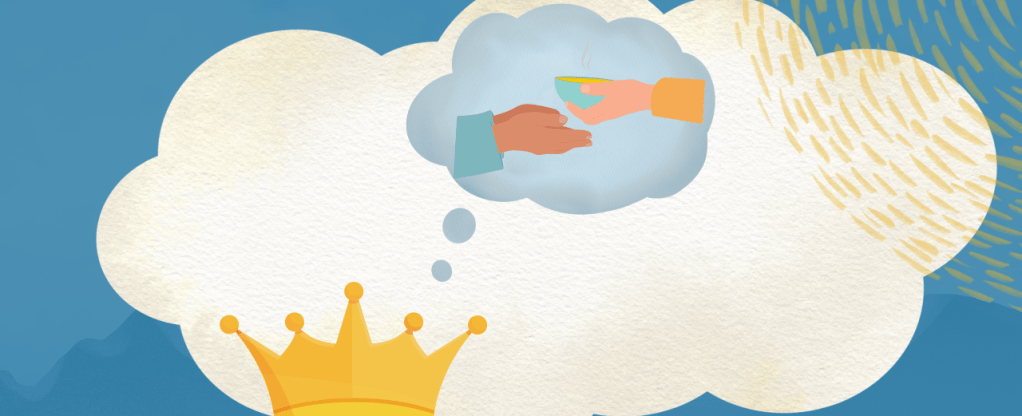
King Janak’s Dream

Have you ever felt confused by the different sides of life?

“Am I someone who can shape my future — or am I just pushed around by what life brings?”
“Am I kind and caring — or do I become selfish when I feel threatened?”
“Am I strong enough to stay calm during ups and downs — or do I fall apart when something I love is taken away?”

The story of King Janak’s dream gives us some insights into these questions. And how we can find joy amidst life contradictions. 

When The King Fell Asleep

King Janak was known not only as a wise and able ruler, but also as a seeker of truth. A rare blend of king and yogi — a raja-yogi.

One day, the king fell asleep on his throne. Suddenly, the palace guards rushed in to wake him: a neighboring kingdom had launched an attack. Janak leapt up, wore his armor, and led his army into battle. But despite their brave efforts, they were defeated. The enemy took over the kingdom, and Janak — wounded and weary — wandered through the city looking for water.

But now he was no longer king. A new king had taken over. No one dared to offer Janak even a sip of water, for fear of angering the new king. He left the town in search of water, and by now he was very hungry too. 

After some distance, he found a place where food was being distributed to the poor. He stood in line and waited for his turn. Unfortunately, by the time it was his turn, the food was over. He requested the people serving food to scrape the bottom of the barrel and give him whatever was left. They obliged and gave him some scraps on a leaf plate. He sat under a tree to eat, but just then a kite swooped down to catch a prey. Janak was startled  and the plate fell off his hands. That was the final blow. Hungry, tired and defeated – he broke down in tears. 

At that moment, the guards shook him awake. 

“Your highness! Why are you wailing in your sleep? What happened?”

Janak opened his eyes and looked around. He was back in his palace. Still the king. It had all been a nightmare.

The Inquiry Begins

Any ordinary person would have simply been relieved to know that this was all just a dream. But King Janak was a seeker of meaning. He began to wonder

“Was that real? Or is this real?”

The next few days, he kept repeating this question. Whoever he met – his advisors, friends, wellwishers – Janaka had the same question. 

Most people dismissed it lightly. “It was just a dream. It wasn’t real. This is the real world.”

But Janak was not convinced. “In the dream, everything felt so real. The hunger, the shame, the tears — I felt it all. Now it is all gone. What if this palace too — all that I see now — is also like a dream?”
The Sage Arrives

News of the king’s dilemma reached the great sage Ashtavakra. He came to visit Janak and heard him out.

Ashtavakra smiled and asked:
“In your dream, you felt defeated and miserable. Do you feel that way now?”

Janak shook his head.

“So the dream is gone — it was unreal. Now tell me — all this palace, the guards, your power — did any of it exist in the dream?”

Again, the king shook his head.

Ashtavakra said,
“That dream showed you something. That everything you hold today — your wealth, your power, your identity — can disappear in an instant. That is the nature of life. Things change. And when your time comes to leave this body, you will leave all of this behind.”

“The dream was not real. But neither is this waking world. Both come and go.”

So What Is Real?

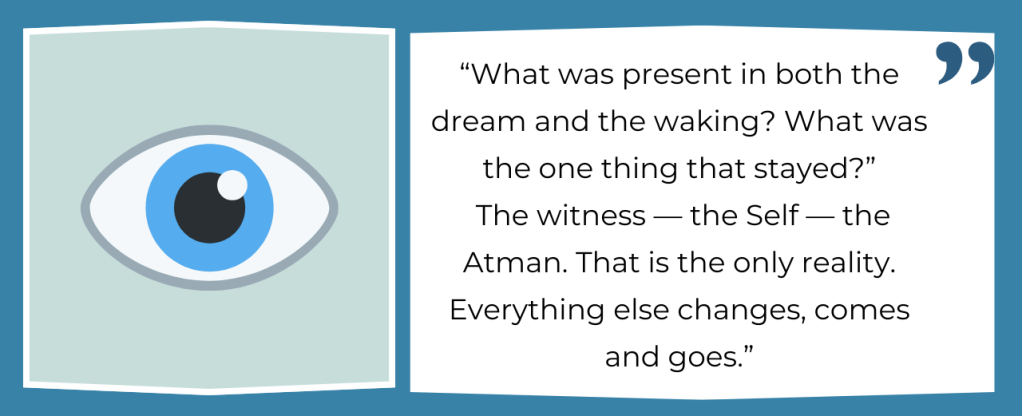
Ashtavakra continued: “What was present in both the dream and the waking state? What was the one thing that stayed?”

Janak was silent. Ashtavakra said:
“It was you. The one who saw the dream. The one who is asking these questions now. The witness — the Self — the Atman. That is the only reality. Everything else changes, comes and goes.”

Reflection Question

What is something you’ve been able to let go of, after realizing how temporary life really is?


Discover more from The Sabad Project – Wisdom stories

Subscribe to get the latest posts sent to your email.


Comments

5 responses to “King Janak’s Dream”

  1. The Sabad Project Avatar
    The Sabad Project

    From Harmeet Sindhkar

    Sundar story hai.
    What I liked the most was the question — Who remains the same?
    The king himself.

    Everything else — the kingdom, relatives, wealth — is left behind. In just a fraction of a second, the world changes for us as we take our last breath. Life goes on. Nothing really changes, because no one is indispensable.
    Of course, those close to us are affected, but they don’t have a choice.

    All our worries and anxieties are linked to the body. But what we think in our final moments decides the journey of our next birth. Rarely do people remember Him. Most of the time, we are thinking about wealth or loved ones. And our loved ones don’t even know how we feel in those last moments — we are no longer able to share that experience.

    But yes, only He comes and takes us to His abode.
    As Bapu says, this life is like a boarding school — our true home is with Parmatma.

    Like

  2. G Madan Mohan Avatar
    G Madan Mohan

    As the learned saints and scriptures explain that in semi-darkness a rope on the floor looks like a snake and suddenly fear grips. However, with the use of light, the same is realised as illusion and fear is subdued.

    Scriptures also explain that Supreme Consciousness, the Eternal, the Creator, Sustainer and Ultimate Destroyer is THE TRUTH. However, persons identify themselves with the physical body out of ignorance. The living beings are truly minute specks of Supreme. But, instead, the individual feels that all the actions of his sense organs are done by him. The sense of desire to acquire material things, is the cause for anger, fear, grief etc.

    In dream state the mind is active and all the sense organs are inward projected. Hence all the sequences are taken as real and dreamer feels all the emotions. Once he is awakens he realises that as illusion and feels relieved.

    The worlds, dream and awake, are illusory. To attain the knowledge of Supreme Consciousness is the only way for salvation and to be free from the cycle of birth, death and rebirth. Lord Krishna says, Ch 11 – Sl 8, to Arjuna —

    “You cannot see my Vishvaroopam with your physical eyes. I am blessing you with Gnananethra to see.”

    For understanding the Reality, the sense of knowledge of the Supreme is the only guidance for which intense bhakti and gnyanayoga are the ways.

    Like

    1. Thanks for sharing your reflections. That image of the rope being mistaken for a snake is so relatable. It’s amazing how often we get caught up in our own false perceptions, even when we’ve seen through them before.

      Thanks for sharing the references. The teachers of wisdom have shown us the way, but we keep needing reminders. Conversations like this are helpful nudges to keep exploring what truly matters.

      Like

  3. Very nice and liberating read. Many thoughts emerge-

    1. The ability to reflect is not common, but that is the only way we transform. As someone said reflecting is a purposeful, painstaking effort, but one finds light at the end of the tunnel. The story beautifully brings it out.

    2. In academics, there is always a debate about the ‘truth’. The present day curriculum all over the world including India has western epistemology as the base. If we take Indian epistemology as the base, it will have radical implications to curriculum and pedagogy. The truth, brahman or self is far ahead of the ‘Justified true, belief’ framework of western philosophers.

    3. The impermanence of the physical body, desire, and physical things should not make us disconnected or disinterested in life. It is through indulgence in this material world and experiencing it deeply, liberates us from it. This material world is the means to realise the non- material world or the ultimate reality. Unless one indulge, one cannot get liberated.

    Many thanks Gurpreet, for lucidly written, thought provoking piece of writing.

    Like

    1. Thanks, Arun, for sharing your thoughts. You’re right—when we look at where we are today, both personally and as a society, it’s clear how even small shifts away from foundational truths can completely change our direction, like a ship drifting off course.

      Over the years, I’ve also found myself questioning some of the things we were taught to take for granted. For example, why is GDP growth considered the key marker of progress? Why isn’t access to a decent quality of life given more importance when we measure economic success? And how exactly does endless consumption lead to greater wellbeing? 🙂 These were never really challenged when we studied economics, business, or other subjects—they were just the default assumptions.

      We talk about wanting children to be technologically savvy—but that often just means keeping up with AI. We should also think of technology to clean up the garbage that surrounds us, to reduce chemicals and toxins in our plate, and to improve the quality of life for our own parents.

      Here’s to gently questioning those defaults, shifting the narrative, and slowly adjusting our sails toward something more meaningful and grounded.

      Liked by 1 person

Leave a reply to Gurpreet Sethy Cancel reply