
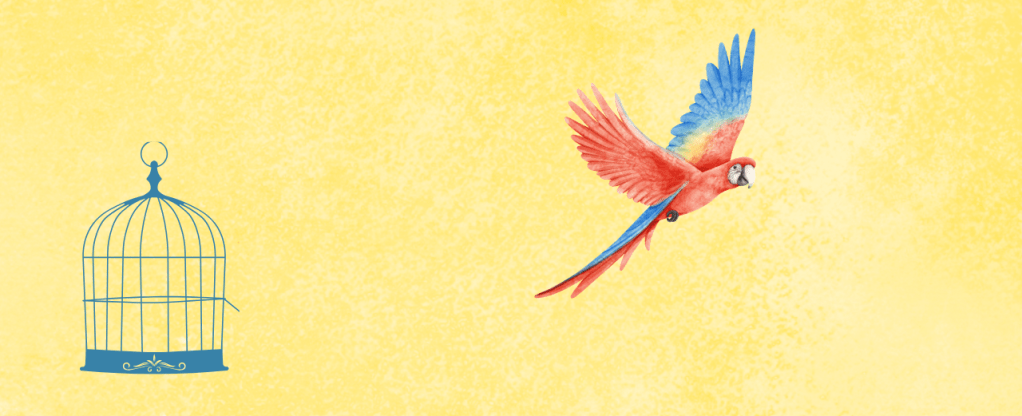
Are there problems that are making you lose your peace of mind? Do you sometimes long to be free of your burdens? The tale of a parrot and a sage might hold a key to understanding our own struggles.
The Parrot’s Question
A rich merchant once owned a parrot. It lived in a beautiful cage hanging from a mango tree in his garden. Every day, a tailor would walk past on his way to meet a sage who lived beyond the town.
One morning, the parrot called out, “Where are you going?”
The tailor replied, “To visit a sage in the forest. He helps me make sense of life’s troubles.”
With longing in his eyes, the parrot pleaded,
“I want to be free—to spread my wings and soar under the open sky. But I’m trapped in this cage.
Will you please ask the sage what I should do? Can you promise me you’ll ask him, and bring back his answer.”
The Tailor’s Regret
The tailor agreed and faithfully remembered the parrot’s words. That day, as soon as he met the sage, he asked the question.
The sage heard it—and collapsed. He lay motionless for several moments. The tailor panicked. Had he made a terrible mistake? When the sage finally returned to consciousness, the tailor didn’t dare speak of the parrot again.
On his way back, the tailor passed the merchant’s garden. The parrot spotted him and called out eagerly,
“Did you ask the sage? What did he say?”
The tailor was very embarrassed. He replied,
“I am very sorry. I should not have promised to ask your question. I don’t know why – but as soon as I asked the question, the sage collapsed to the ground. He wouldn’t talk, nor move nor respond. I am very sorry, but I cannot ask him again.”
The Message Delivered
The parrot’s eyes lit up. He had understood the sage’s answer.
The next morning, he lay belly up in the cage—silent, unmoving. He wouldn’t eat or drink. The merchant, thinking the parrot had died, grew sad. He carried the cage outside the town, opened the door, and gently laid the bird on a rock.
But as soon as he turned away, the parrot opened his eyes—and flew to a nearby tree.
From the branch, he started singing songs of gratitude to the sage, whose mysterious response gave him an important lesson:
As long as you are ‘alive’ in your desires,
You remain trapped in the cage of circumstance.
When you become ‘dead’ to the world,
With no desires or expectations of how circumstances should be, you become truly free.
What It Means to Be “Dead to the World”
Spiritual traditions teach that death comes in two forms:
- The death of the body, which comes to all.
- The death of the mind, which is the gateway to true life.
As Kabir ji puts it:
Kabir marta marta jag mua mar bhi na janeya koi
Kabir, the world has been dying, everyone has to die. Yet no one knows the real way of dying.
Aise marne jo mare bahur na marna hoi
Those who learn to truly die (to Maya or the false perceptions of this world), will not have to die again
– Guru Granth Sahib, Ang 1365
Death of the mind means letting go of our constant thoughts about how life should be. It means learning to go with the flow of life. It’s like opening the door of a bird’s cage. When we let go of our fixed ideas and expectations, we break the chains we have built around ourselves. We can then spread our wings and fly freely through the sky of life — truly free.
How Can We Live This Wisdom?
Here are two ways to approach this, depending on your situation:
Baby Step – A Small Experiment
Think of a tug-of-war. The struggle continues only as long as both sides pull. What happens when one side lets go? The game ends.
Conflicts in relationships are similar. They persist when both sides cling to their expectations. But you don’t have to wait for the other. If you let go, you can free yourself.
Giant Leap – Living with Inner Freedom
Guru Teg Bahadar ji, the ninth guru of the Sikhs, throws some light on what it means to live life with this wisdom. The shackles of expectations in our daily life that hold us back. And suggests how we can live free by gradually letting go of them through conscious reflection:
The one who feels no pain in sorrow
Doesn’t cling to pleasures or the fear of tomorrow,
To whom gold and dust are both the same,
Unshaken by slander, praise, or fame,
Free from greed, attachment, or claim;
Above all sorrow, beyond all delight,
No pride in honor, no shame in slight.
With hope and craving cast aside,
In worldly things does not abide;
Whom lust and anger cannot sway—
In such a heart, the One does stay.
The one blessed by the Guru’s Grace
Is able to understand these ways,
O Nanak, one with God they be,
Like water merged into the sea.
Sources
- Ragi Harbans Singh Jagadhri Wale – Katha: Naam Samaal Too
- Jalaluddin Rumi – Masnavi: The Parrot and the Merchant
- Bhagat Kabir – Guru Granth Sahib
- Guru Tegh Bahadar Ji – Guru Granth Sahib
Reflection Question
Have you ever let go of an attachment—and discovered a new kind of freedom?

 The Sabad Project - Wisdom stories
Leave a comment