
How do you treat someone with immense wealth? Now, how do you treat someone who not only flaunts their wealth but constantly reminds others of it? Imagine that they constantly challenge those with lesser wealth with the intent to grab theirs as well!
Most of us would agree—enjoying one’s wealth and to an extent celebrating it publicly has its place. But using it to belittle others or assert dominance? That’s crossing the line of decency.
Now, let’s replace the word ‘wealth’ with ‘knowledge.’
While pride in material possessions is often criticized, pride in knowledge and virtue can be equally dangerous. It’s more subtle but no less harmful. Pride in one’s learning or moral achievements can make us judgmental and blind to the struggles of others.
We judge people by their degrees, the institutions they’ve studied at, or the accolades they’ve earned. But these accomplishments mean little if they breed arrogance, are used to humiliate, or serve self-interest at the expense of others.
A Story from Ujjain
In this story, let’s travel back hundreds of years to the kingdom of Ujjain, ruled by the learned and celebrated Raja Bhoj. Ujjain was a hub of knowledge, attracting scholars from far and wide who engaged in public debates to demonstrate their learning. These debates weren’t just intellectual duels; they were spectacles, drawing crowds eager to witness the battle of minds.
One day, a famous scholar arrived in Ujjain. Known for his cleverness, he had defeated scholars across the land and was determined to conquer every learned person in the world. But he didn’t just stop at debates—he had a condition: if he won, the defeated scholar had to surrender all their books. If he lost, he’d do the same.
This scholar’s arrival caused panic among the local intellectuals. His reputation was formidable, and no one wanted to lose their cherished books—or their pride.
Then, an unlikely prediction came from a local astrologer:
“There’s an oil-presser in this town who can defeat this arrogant scholar. His pride is his undoing.”
The local scholars, desperate for a solution, found the oil-presser—Gangu Teli, a one-eyed, humble man who had never been to school. They begged him to help, explaining their plight. Gangu, though baffled, agreed to challenge the newly arrived scholar. Gangu was however perplexed as to how he should debate the scholar since he was unlettered. The scholars of Ujjain told Gangu not to worry, that he had the King’s support and he could say whatever came to his mind.

On the day of the debate, Ujjain’s scholars dressed Gangu up as one of their own—robes, wooden sandals, the whole scholarly appearance. But the new sandals hurt his feet, so Gangu removed them, carefully wrapped them in cloth, and carried them under his arm as he walked to the debate. In a hurry, he forgot to leave the sandals behind when he went up the debate stage, and embarrassed, he placed them next to himself like a pile of books!
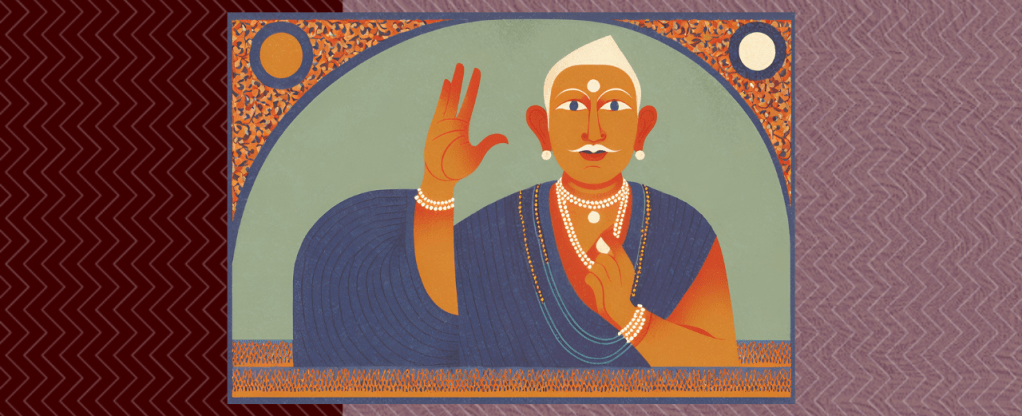
When the debate began, the visiting scholar suggested they start with gestures before moving to words. Confident, the visitor raised one finger, symbolizing the oneness of God.
Gangu, unfamiliar with philosophical gestures, interpreted it his own way. He thought the scholar was mocking his one eye and threatening to take it out. So, he raised two fingers—“If you take one of mine, I’ll take both of yours!”
The scholar saw this differently. He thought Gangu was saying, “God is one, but manifests in duality—in form and formlessness.” Impressed, he continued.
Next, the scholar raised five fingers, signifying the five vices—lust, anger, greed, attachment, and pride, that veil the human soul from God.
Gangu thought, “He’s threatening to slap me!” So, he responded with a clenched fist, meaning, “I’ll punch you back!”
The scholar interpreted this as profound wisdom: “Ah, he means that when the five vices are conquered and controlled, the soul can realize God.”
The scholar was thoroughly impressed and declared Gangu a worthy opponent.
Next came the verbal round. The scholar asked, “On which text shall we base our debate?”
What books? Gangu had never read any. Remembering the scholar’s advice to say whatever came to mind, he looked around. His sandals were placed beside him on the stage, wrapped in a piece of cloth. The bundle looked like books! So, he pointed to it and said, ‘The Kantak Churan Purana’—literally, ‘The Treatise on Crushing Thorns,’ a reference to his sandals.
The visitor was stunned he had never heard of this “book”! He racked his brains, finally apologized and requested time to study it before continuing the debate – essentially conceding defeat!
When the truth was revealed—that Gangu was no scholar and the ‘Kantak Churan Purana’ was nothing but his sandals—the visiting scholar was humiliated. “You used a sandal in place of a book?” he protested. Gangu replied, “Aren’t you using your book as a sandal? As a weapon to defeat others and prove your superiority?” – a retort which hit the mark as the visitor realised the gravity of his actions so far.
The scholar’s arrogance, born of pride in his knowledge, had blinded him. His intellect had become a tool for conquest, rather than enlightenment. Gangu, the unlettered oil-presser, unintentionally taught him—and us—that knowledge, when used to dominate or demean, is as worthless as a sandal used to strike someone. The intellect of the head must be paired with the humility of the heart. It should be used not just for personal growth and stature, but for serving the world.
References
Translated and adapted from Do Divay Ik Joti, by Giani Jaswant Singh ji Parwana.
Audio comment – Bhikku Aruno

Listen to an audio comment from Bhikkhu Aruno. Bhikkhu Aruno is an Indian-Thai Buddhist monk ordained in the Dhammayut tradition, closely following the Forest monastic practices of Ajahn Mun.
Reflection
How can you use your gift of learning to help others?


 The Sabad Project - Wisdom stories
Leave a reply to Gurpreet Sethy Cancel reply