
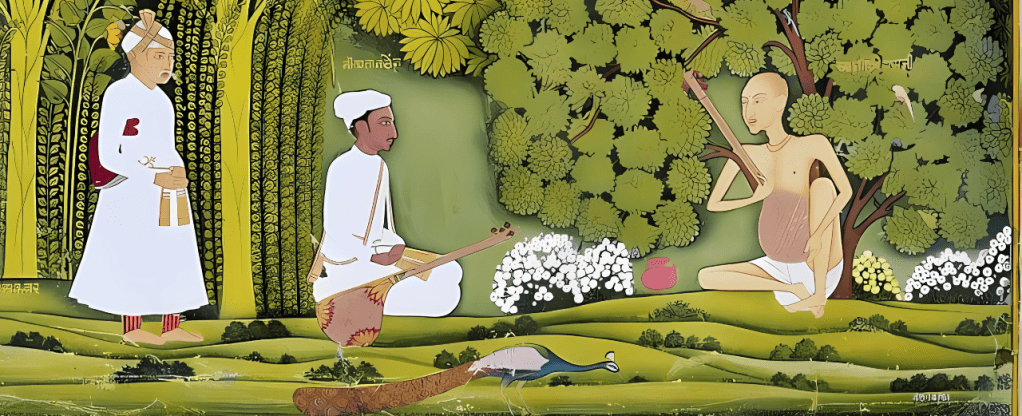
Tansen and His Teacher | The Shadow and the Spark

Tansen, the legendary singer, was one of the nine jewels in Emperor Akbar’s court. It is said that when he sang Raag Malhaar, it would begin to rain, and when he sang Raag Deepak, lamps would light up.

One day, after a mesmerizing performance of Raag Darbari, Emperor Akbar was spellbound. Praising Tansen, he said, “There has been no greater musician than you, and there never will be.”

Tansen bowed humbly but replied, “Thank you, Your Majesty. However, it is not true that I am the greatest singer. In fact, even now, there is someone whose music far surpasses mine.”

Akbar was astonished. Someone better than Tansen? “Who is this singer? Bring him to my court—I want to hear him. I cannot believe anyone could be greater than you.”

Tansen smiled and replied, “He cannot be brought here. He is my teacher, Swami Haridas, who lives as a hermit in Vrindavan.”

Intrigued and determined, Akbar insisted, “If he cannot come here, then take me to him.”

A glimpse of the master

Tansen agreed. The two traveled to the forest, where Haridas lived a life of quiet simplicity, far removed from the world. Akbar hid behind the bushes, as Haridas would never sing to please any earthly king.

As night fell, Swami Haridas began to sing. His music was an offering, an act of pure devotion to Krishna, the Divine Beloved. It wasn’t just a performance—it was a bhajan, a heartfelt prayer that dissolved all barriers between the singer and the Divine.

The sound of his music was unlike anything Akbar had ever experienced. It seemed to arise from a place of complete surrender, where ego and self-consciousness had no place. Akbar felt his mind still, his heart overflow with peace, and time itself fade into eternity.

On the way back, still spellbound, Akbar turned to Tansen and asked, “I have heard you sing countless times, and your music always moves me deeply. But tonight, your teacher’s music was different—it was divine. Why can’t you sing like him?”

Tansen replied with a serene smile, “Your Majesty, I sing in the court of a king. I sing with the desire to please you. My mind is on the applause and rewards I may receive. My teacher sings only to please the King of all worlds.”


I sing with the desire to please you…My teacher sings only to please the King of all worlds.

Acting in the world, not of this world

Swami Haridas was a mystic and musician. He made important contributions to the bhakti movement. His name, Hari-Das, literally means “slave of God”. He composed songs celebrating the love of Radha and Krishna – symbolizing the longing the soul has for the Divine. He didn’t sing for any acclaim or reward. He sang to offer his life to the Divine. 

Spiritual masters teach us that this is the ultimate purpose of life – to discover the Divine within. We are not material beings on a spiritual journey; we are spiritual beings navigating the material world. Forgetting this truth creates a sense of separation from who we truly are. All sacred traditions aim to help us remember this eternal truth. 

To live for this Truth is to engage with the world while holding the Divine firmly within our hearts. It is to act in the world without being of the world.

Source: Discourse by Giani Pinderpal Singh
Image Credit: Wikimedia Commons

Reflection question

What expectations can you let go of in order to move closer to the ideal of life embodied by Swami Haridas?”


Discover more from The Sabad Project – Wisdom stories

Subscribe to get the latest posts sent to your email.


Comments

7 responses to “Tansen and His Teacher | The Shadow and the Spark”

  1. Reading the divine itself is a divine experience. Pleasure to read Gurpreet. Very well explained, one can feel the divine.

    Like

    1. Thanks for reading Arun, and for sharing your reflection!

      Like

  2. this is beautiful. I particularly loved the articulation of how and what motivates Haridas. It’s the intrinsic value and not may extrinsic desire. Very nicely written.

    Like

    1. Thanks Gowtham. It is interesting how much of our education and workplace conditioning makes us look outside.

      Like

  3. This is such a beautiful story with a profound message. I have been reading it multiple times, allowing its message to wash over my being and deeply resonate within me.

    I hope that being inspired by a higher, deeper way of living—one more connected with the divine—will gradually guide me and naturally help me release the expectations and compulsiveness that come with our temporary worldly engagements.

    Like

  4. Thank you, Uthra!

    I was recently listening to a discourse where the speaker shared a very practical suggestion: “When you hear wisdom nuggets or stories, they may make you feel good for some time. But to truly benefit, ask yourself—what are my thoughts and actions, and how do they compare with what wisdom suggests?”

    Inspired by that tip, I’ve been reflecting on the story and observing my own thoughts over the past few days. It’s been eye-opening to realize how much of the way we operate can often be the opposite of what wisdom teaches us.

    Making big changes overnight might not be easy. But we can begin with small steps, one at a time. The spider from King Bruce’s story comes to mind—even if we succeed sometimes, stumble at other times, we must keep trying.

    Liked by 1 person

    1. Having a deep connection with God is like tasting the ultimate nectar of life, a sweetness unmatched by any worldly temptation—the very state Haridas was in. Perhaps this is why the wise Tansen recognized that it was impossible to imitate Haridas, clearly understanding that his teacher had reached a level of devotion and surrender he had yet to attain. Tansen also openly admitted, without any feelings of inadequacy, that his mind was still entangled in expectations of rewards and accolades.

      This story reminded me of a discourse by the Chinmaya Mission I attended around a decade ago. It illustrated how letting go becomes effortless when we experience something greater. If you ask a child to give up a toy, they will resist. But as they grow and discover greater joys, the toy gradually loses its charm. Similarly, giving up the lesser (worldly temptations) becomes easier when we sustain our connection with the greater (bonding with God).

      While self-reflection as a tool to tame the mind has its place, it can sometimes feel like a strenuous effort, as though we are constantly measuring ourselves against an ideal. For Haridas, Bhakti Yoga (the path of devotion) alone was sufficient; he likely didn’t require the arduous path of reflection or Jnana Yoga to transcend the temptations of the world.

      Though I’ve always resonated with reflection and the contemplative path of Jnana Yoga, this story deeply touched my heart. The vivid portrayal of Haridas’ Bhakti awakened a dormant longing within me for devotion to take precedence in my spiritual journey. Thank you so much for sharing such a moving narrative.

      Like

Leave a reply to Uthra5 Cancel reply