
One of the famous saints from the bhakti tradition was Bhagat Dhanna ji from Dhuan Kala village, near Tonk district in Rajasthan. He was a simple man born in a farming family. One day, while heading to his fields, he observed a priest performing his daily rituals with what appeared to him as ordinary stones. Curious, he approached the priest and asked, “What are you doing with these stones?”
The priest, slightly irritated by the farmer’s naïveté, corrected him. “These are not stones,” he explained. “This is Thakur (a term used to address Lord Krishna), and I am offering prayers to Him.” Dhanna Ji watched as the priest ceremonially washed the idol and placed a plate of food before it.
“What are you doing now?” Dhanna Ji inquired.
“I am offering food to Thakur. I will eat only after He has eaten,” replied the priest.
“Why do you offer food to Thakur?”
The priest explained, “When we please Thakur by offering food, He takes care of all our tasks.”
A spark of realization lit up Dhanna Ji’s mind. “So, He can do all kinds of work?”
“Everything,” said the priest confidently.

Faith in Action
The priest’s words stayed with Dhanna Ji, who saw in them a solution to his struggles. The next morning, he returned to the priest and said, “I am having difficulty managing my farm. Please give me a Thakur too. He can help me with my work.”
The priest, now exasperated, tried to brush him off, but Dhanna Ji persisted. To rid himself of the farmer’s insistence, the priest picked up a random stone, wrapped it in a cloth, and handed it to Dhanna Ji, saying, “Here, this is your Thakur.”
Overjoyed, Dhanna Ji took the stone home. He bathed it, prepared a delicious meal, and earnestly placed the food before it. “Thakur, please eat,” he urged. However, the stone remained still.
Determined, Dhanna Ji continued his efforts. “I won’t eat until you do,” he pleaded. He tried every possible way to coax the Thakur—requesting, goading, shouting, and even crying—but there was no response.
For two days, Dhanna Ji fasted, his energy waning. Moved by the sheer sincerity and innocence of his devotion, God finally manifested as a young man.
When Dhanna Ji saw Him, his joy knew no bounds. “Thakur! You’ve come!” he exclaimed, offering the plate of food, which God ate heartily. From that day on, Dhanna Ji and Thakur worked side by side on the farm, sharing meals and songs.
True Devotion
A few days later, the priest happened to pass by Dhanna Ji’s house. Seeing the priest, Dhanna Ji ran up to him, brimming with gratitude. “Your Thakur is amazing! He’s been helping me so much. Come, taste the food He made!”
The priest was startled. “Your Thakur makes food?”
“Oh yes,” Dhanna Ji replied enthusiastically. “And He sings too! You must listen to Him sing. He has completely transformed my life. Look at how much He works on the farm!”
The priest, skeptical, followed Dhanna Ji to his fields. There, he saw cows plowing the land, but while Dhanna Ji could clearly see Thakur guiding the plow, the priest saw nothing.
“Why can’t I see Him?” the priest asked.
“You see Me because your faith is pure and unwavering. The priest, though he worships Me outwardly, is consumed by attachment to material desires.”
That evening, Dhanna Ji asked Thakur about the priest’s inability to see Him. God replied, “You see Me because your faith is pure and unwavering. The priest, though he worships Me outwardly, is consumed by attachment to material desires.”
Humbled by this response, Dhanna Ji became apologetic. “I have treated You like my friend and farm help. Please forgive me for not showing the reverence You deserve.”
God smiled and reassured him, “It is your devotion and sincerity that have allowed you to see Me in this form. There is no need for apology. Remember, you can see Me anytime and anywhere—you only need to start looking within.”
Lessons from Bhagat Dhanna Ji
This story of Bhagat Dhanna Ji illustrates that true devotion doesn’t depend on scholarly knowledge, ritualistic correctness, or social status. Instead, it is the innocence and sincerity of the seeker that bridges the gap between the soul and the Divine.
The priest, in frustration, handed Dhanna Ji an ordinary stone to avoid his questions. But Dhanna Ji’s unwavering faith transformed that stone into a living presence of God. His belief allowed him to experience what even the learned priest could not.
There are many paths to worship, but the goal is the same: to see the Divine not just in the object of our devotion, but in all of Creation.
Sources
- Discourse by Giani Pinderpal Singh Ji
- Vaaran, Bhai Gurdas
- SikhNet, The Story of Bhagat Dhanna Ji
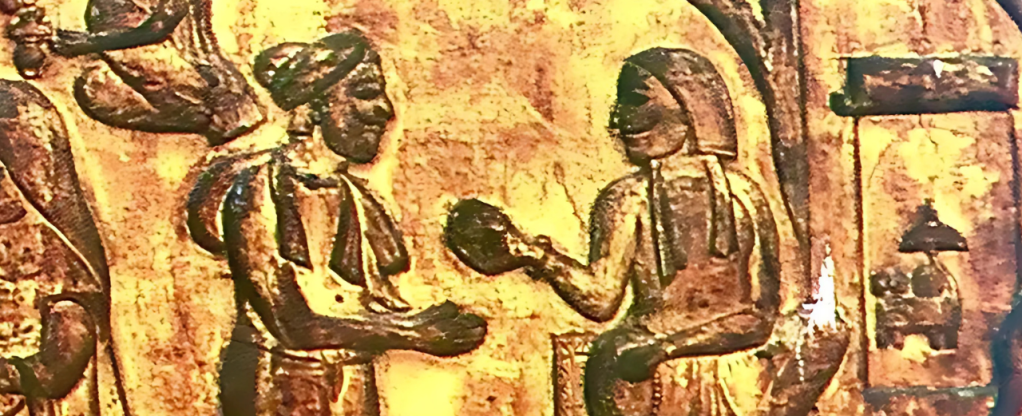
(Image credit: Wikipedia, gilded panel crafted by the artisans of Kucha Fakirkhana depicting the life of Bhagat Dhanna)
Reflection Question
Have you ever prayed for a material need that was answered? How did that experience deepen your faith, not just in fulfilling that specific need, but in connecting to something greater?


 The Sabad Project - Wisdom stories
Leave a comment