
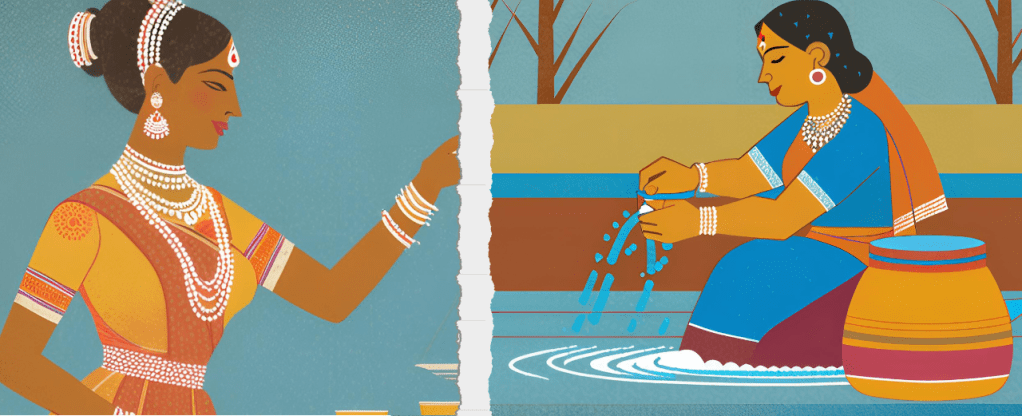
Kabir Ji, a renowned Bhakti saint, lived in Benaras. One day, as he sat by the river ghat, the king’s grand caravan arrived, accompanied by his queens. The sight dazzled the pilgrims, who were awestruck by the display of royalty and opulence. The queens, draped in fine clothes and adorned with precious jewels, descended from their regal carriages. Elephants, horses, and luxurious vehicles completed the royal entourage.
This reaction to luxury is something we can still relate to today. Modern advertisements often use words like exclusive, splendor, luxury, premium, and radiant, tapping into our fascination with opulence.
Back at the ghat, amidst the murmurs of admiration, one of the pilgrims asked Kabir Ji, “Aren’t these queens beautiful? They look like they belong to another world.” Kabir Ji, however, glanced toward the other side of the ghat, where a simple woman was drawing water from the river to serve the pilgrims. He quietly remarked, “Better than them is this water carrier who serves the devotees of God.”
The pilgrims were puzzled. How could this woman, in her plain and soaked clothes, be compared to the dazzling queens? Kabir Ji’s wisdom often defied conventional thinking, challenging perceptions of beauty, wealth, and power. The water carrier, with no adornment and no servants, was toiling away, while the queens could command many with a mere glance or gesture.
Kabir Ji’s verses in the Guru Granth Sahib reveal the wisdom in his remark:
Kabir nirap naari kyun nindiye har cheri kyun maan
Kabir, why do you slander the wife of the king? Why do you honor the servant of the Lord?

Oha maang savaare bikhai kau oha simarai har naam
Because one (the queen) dresses to arouse desire, while the other (the water carrier) remembers the Lord's Name.
(Sri Guru Granth Sahib, Ang 1372-73)
Kabir Ji was pointing out a deeper truth. While the queens appeared to live in luxury, their inner world was often fraught with anxiety and competition. They were part of a system where kings married multiple women for political power, and queens had to vie for the king’s favor. They spent hours on elaborate beauty routines, experimenting with intoxicating perfumes and seeking magic potions from advisors skilled in the art of seduction. Their lives, though outwardly glamorous, were inwardly consumed by desire and intrigue.
In contrast, the humble water carrier, in her simple act of service, had her mind focused on the divine. She wasn’t competing for attention or status but was content serving pilgrims, seeing the face of God in each of them.
This story reminds us that in the grand scheme of life, material wealth and indulgence do not satisfy the soul. Life is short, and while caring for our bodies and loved ones is important, accumulating wealth and luxury is not the true purpose. Desires, once indulged, only grow, leaving the mind restless. When the time comes to leave this world, none of our possessions will come with us. As Nimo Patel of Empty Hands Music says, “We arrive on this planet empty-handed, and we will all soon leave empty-handed. So how do we want to spend the time in between?”
Sources
- Sri Guru Granth Sahib, Ang 1372-73
- Katha by Giani Pinderpal Singh Ji
Reflection
This story prompts us to reflect on the desires we pursue. Have you overcome a personal obsession—big or small—to live more meaningfully? Share your experiences here to inspire others.


 The Sabad Project - Wisdom stories
Leave a comment