
We all carry expectations of others — our friends, family, or people we work with.
Inevitably, there are moments when they do not behave the way we expect them to.
How do you respond when someone does not say, do, or be what you expected?
What happens within you at such times?
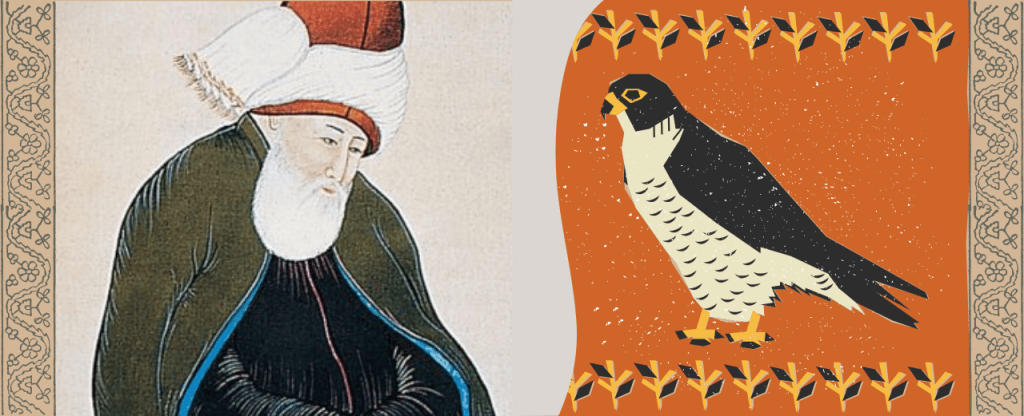
Rumi’s Masnavi shares a story of a royal falcon who lands at the door of an old woman—offering an important lesson for our own life experiences.
The Royal Falcon
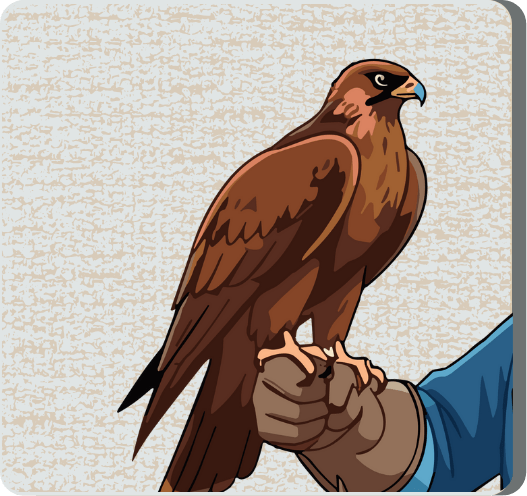
The falcon is a majestic bird, known for its sharp vision and its ability to soar high with precision. Kings once trained falcons for hunting. Over time, the falcon came to symbolise power, wisdom, and even divinity. Portraits of many kings and saints show a falcon resting on a gloved hand.
These birds were the king’s hunting companions—they flew out at his command and always returned to their master.
The Falcon Wanders Away
In the Masnavi, Rumi tells the story of one such royal falcon that wandered away from the palace and landed at the doorstep of an old woman.
Enchanted by the bird, she lifted it gently and placed it on her lap. She offered it barley and water.
Seeing its sharp talons, she wondered, “Who has kept you so neglected? Look how overgrown your nails are,” and clipped them. Stroking its wings with motherly affection, she frowned again. She tied its legs and cut its feathers so it would not fly away.
The falcon did not resist.

Away From Home
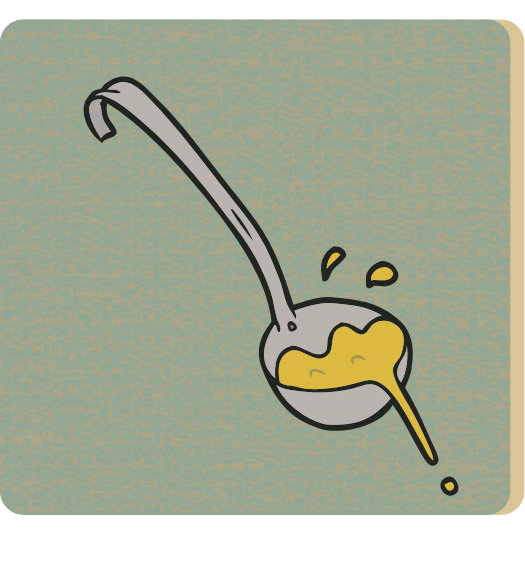
She brought broth meant for her children and placed it before the bird. But the falcon could not eat such food—it was accustomed to the king’s hand. She pushed the plate closer, urging it to eat. The bird refused.
The woman grew angry.
“I care for you so much, and this is how you respond?”
In her rage, she poured hot soup over the falcon’s head.
The falcon remembered its days with the king—flying freely, circling the seas, responding to its master’s call. Tears flowed from its eyes.
The Return
Meanwhile, the king’s attendants searched everywhere for the lost falcon. At last, they arrived at the old woman’s house.
The falcon was reunited with its master. Seeing the bird’s condition, the king was deeply grieved. The falcon pressed itself against him, aware of what it had lost—and what it had regained. It resolved never to wander away again.
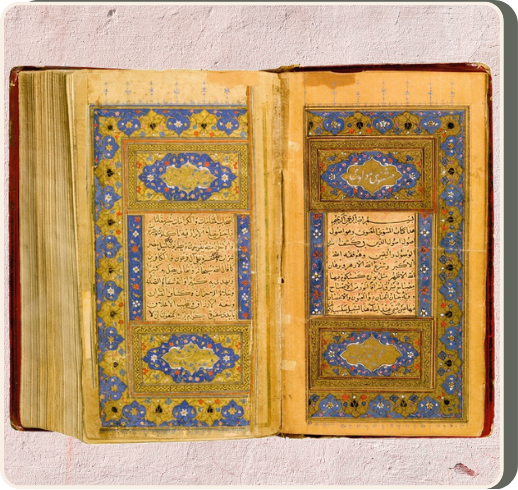
Rumi writes:
The soul is like the king’s falcon.
The world is like the ignorant old woman.
The falcon is mighty and powerful, meant to fly in the open skies.
When it waits at the door of the world, it suffers.
Its strengths are seen as faults by the old woman.
The falcon truly belongs on the forearm of its Master.
The Spiritual Metaphor
The Falcon — our inner strength
In many traditions, the falcon symbolises the soul. Its sharp vision points to inner clarity; its flight, to freedom beyond limitation. It reminds us of our true potential—beyond the constraints of our circumstances. There is an inner strength within us that can help us rise above difficulty, if we remain connected to it.
The Master — our true purpose
Above all, the falcon belongs to the Master. It rises when called, performs its task in the world, and returns when the call comes. Spiritual traditions remind us that human life is not meant only for earning a living or sustaining a family—every species does that. Our deeper purpose is to realize our highest potential: to reflect truth, compassion, and wisdom—to reflect the Divine.
When we choose material gain at the cost of our spirit, we drift away from this purpose. When we choose to live by truth—even at the cost of temporary setbacks—we slowly find our way back home.
The Old Woman — the pull of the world
- The old woman represents the material world. She offers comfort, security, and care—but without understanding the falcon’s true nature. When we stray from our inner source, external supports cannot bring lasting peace. Trying to fit into shallow ideals slowly strips us of our natural strengths.
- Most worldly relationships depend on give-and-take; when benefits fade, bonds weaken. But when we are anchored in our inner source, our sense of fullness no longer depends entirely on circumstances.

Returning to the Source
In Rumi’s poetry, the king’s forearm becomes the soul’s resting place—a symbol of returning to one’s divine source. It is a reminder for moments when we compromise our values for approval, security, or gain. The soul-falcon is called to abide in its inner strength and goodness, rather than waiting at the world’s window.
The longer the falcon wanders, the longer it suffers. So the next time your peace of mind is disturbed, pause and ask:
Where is my falcon placing its hope—on the Master’s arm, or at the old woman’s door?
Reflection Question
When others don’t meet your expectations, what helps you stay anchored—resting your hope on the Master, rather than on people or circumstances?
References
- Shaikh-ul-Arab, Maulana Muhammad Zakariya Kandhlawi. Ma‘ārif-e-Mathnawi — “The Royal Falcon.”
- Dar-al-Masnavi.org. The High Station of Man (Part One).
- Barks, Coleman. The Old Woman and the Falcon, from The Masnavi of Rumi.
- Johnson, Ibukunoluwa. The Falcon in Egyptian Mythology: Symbol of Power, Protection, and Divine Vision.

 The Sabad Project - Wisdom stories
Leave a comment