

Do you see yourself in a role where you are serving someone? You may be caring for parents, children, patients, or a community in need.
Serving others often gives our lives meaning. It can strengthen us from within. And yet, service is not always easy. At times, it tests our patience. It tests our strength.
The person receiving our care may not always show gratitude. There are also everyday challenges—limited resources, difficult situations, or our own personal struggles. Many of us find it easier to serve strangers than those closest to us. With strangers, there are fewer expectations. With loved ones, our service can slowly become mixed with hope, hurt, or disappointment.
And in such moments, a quiet question arises:
What helps us continue to serve, even then?
What keeps service pure, when appreciation is missing?
The Sikh tradition offers a beautiful story that speaks to this question.
The Practice of Langar

Langar — the community kitchen — was begun by the first Sikh Guru, Guru Nanak. Along with meditating on the Divine and earning one’s living through honest labour, the Guru taught his disciples to share their earnings with others. Langar became a living practice ground for this teaching — a way to learn generosity, humility, and service.
The langar was open to everyone, without distinction of faith, social status, or contribution. What began with Guru Nanak was continued by all the Gurus and continues to this day. Disciples were encouraged not only to serve langar at the gurdwara, but also in their homes, so that no one in need would ever go away empty-handed.
When There Is the Real, the Imitation Also Appears
For every real diamond, there are many imitations. This is true of every noble practice. While some follow the ideal with sincerity, others adopt only the outer form, while quietly serving their own interests.
Over time, the Tenth Guru, Guru Gobind Singh Ji, began receiving reports that while some langars were being run in the true spirit of service, others were using the name of langar for vested interests.
There were those who opened their doors to appear generous, but were more concerned with display than with serving those in need. Some served only their patrons, while turning away those they saw as “outsiders.”

Others became more focused on collecting donations in the name of the Guru than on serving the community. Some wealthy disciples appointed staff to manage the langar. Over time, the spirit of service was not carefully watched. The staff kept a tight fist when the needy arrived, and provisions meant for langar were diverted and sold in the market.
The Test of Langar

The Guru decided to see for himself.
Early one morning — at a time when langar was not usually served — he went around the town disguised as a traveler. He wore shabby clothes and covered his face so that no one could recognise him.
He knocked on the door of one place that announced itself as a community langar. A voice from inside replied,
“It is not time for langar. Please come later.”
The Guru walked on and stopped near another place that served langar. This time, he stood back and watched from a distance.
Two poor travellers arrived and asked if there was any food. They were told, “Langar is over. Please go away.”
This place was run by hired staff of a wealthy merchant.
A little later, a group of well-dressed travellers arrived. They were welcomed warmly. “Langar is always ready,” they were told.

The Guru noted what he saw and moved on. At another place, he was turned away again. “It is not yet time for langar. Come in the evening.”
Bhai Nand Lal Ji’s Langar
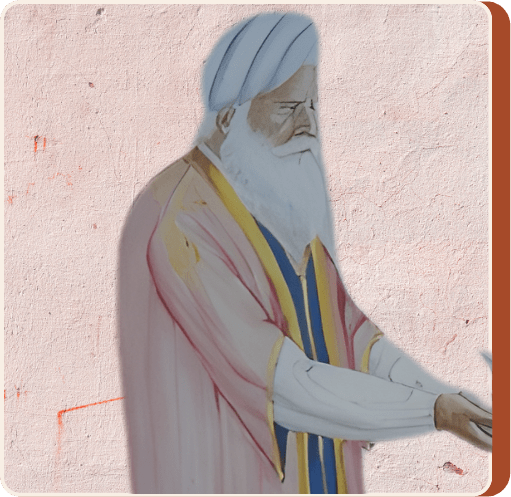
Finally, the ‘traveler’ reached the home of Bhai Nand Lal Ji — one of the fifty-two poets in the Guru’s court, a scholar of Persian, Arabic, and Punjabi.
Despite his learning, Bhai Nand Lal Ji devoted much of his time to langar seva, both at the gurdwara and in his own home.
When the Guru knocked, Bhai Nand Lal Ji opened the door and welcomed him warmly.
“Please come in, Sir. Welcome. Please have a seat.”
“Is langar ready?” the traveller asked, still standing at the door.
With humility, Bhai Nand Lal Ji replied, “The dal is getting ready — it is half cooked. The dough for the rotis is prepared. If you can sit for a little while, I will serve you soon.”
“I cannot wait,” the traveller said, turning away. “I have to go.”
At once, Bhai Nand Lal Ji rushed after him. “Please don’t go. This is the Guru’s langar seva. No one should be turned away empty-handed. If you cannot wait for the food to be cooked, please accept whatever is ready.”
Bhai Nand Lal Ji returned with a pot of partially cooked dal, dough ready to be rolled into rotis, and some butter.
“Please do not go away hungry,” he said.
“For if you do, my Guru Gobind Singh Ji will go away hungry.”

The traveller smiled, accepted the offering, and went on his way.
Back at the Guru’s Court
Later that morning, after the morning prayers, the Guru asked for the people he had visited earlier to be brought before him. He shared with his disciples what he had witnessed.
Had Bhai Nand Lal Ji recognised the Guru’s disguise?
No. He had simply seen the Guru in everyone who walked through his door.

The Guru was deeply pleased.
Turning to his disciples, he said:
“Never turn away a person in need. Offer what you can. To feel another’s suffering as your own — that is the sign of an awakened heart.”
Then, addressing Bhai Nand Lal Ji, the Guru remarked:
“Nand Lal runs the true temple of service. He serves with love and devotion. He cannot bear to see someone in need. His langar has won my heart.”
A Lesson in Service
Bhai Nand Lal Ji’s langar leaves us with an important lesson for our work in the world and our acts of service: to serve each moment as if we are serving the Divine.
As Alcyone says in the book “At the Feet of the Master”, “Think how you would do a piece of work if you knew that the Master was coming at once to look at it.”
And Bhai Nand Lal Goya offers this gentle reminder:
दिल अग़र दाना बवद अंदर किनारश यार हसत ॥
If the heart is pure, you will find the Beloved within,
चशम गर बीना बवद दर हर तरफ़ दीदार हसत ॥
If our eyes truly learn to see, they will see glimpses of the Beloved all around

Reflection question
What helps you keep the spirit of service alive in your heart, even when it becomes difficult?
References
- SikhNet — Langar in Disguise
- Bhai Vir Singh — Kalgidhar Chamatkar
- Kavi Santokh Singh — Dasam Guru Chamatkar
- Giani Pinderpal Singh — Jehṛā Sabar Vich Reh Ke Sevā Karegā
- Bhai Nand Lal Goya — Ghazal 52
 The Sabad Project - Wisdom stories
Leave a comment