
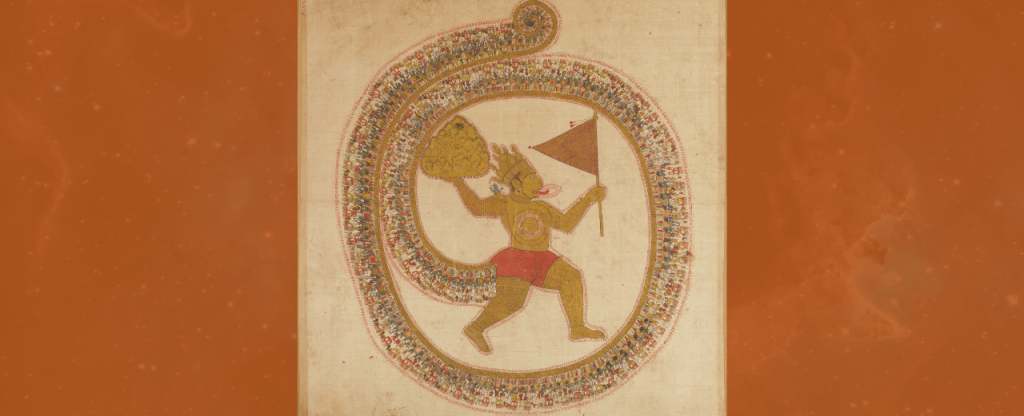
The world teaches us to compete, outdo others, and protect our turf. When we pause to reflect on the deeper meaning of life or show compassion toward others, we often worry that we might “lose” the game of life — or be seen as lacking ambition.
Spiritual traditions, however, show us a different path — the way of selfless action: working with dedication to fulfil our responsibilities, but without attachment to the results.
But the question arises, how do we actualize this ideal in our lives??
The life of Sri Hanuman offers us some of the most humorous — yet deeply insightful — lessons on what it means to serve without self.
The Symbol of Selfless Service
Sri Hanuman is revered as the symbol of selfless service. He worships Sri Ram and embodies the highest form of devotion (bhakti). Though immensely powerful, he never uses his strength for self-glorification. His power is always at the service of his Master.
When Lord Hanuman flew to Lanka in search of Sita Devi, he could have brought her back himself — but he didn’t. He knew his role was only to deliver Sri Ram’s message. The battle with Ravan was Sri Ram’s to fight.
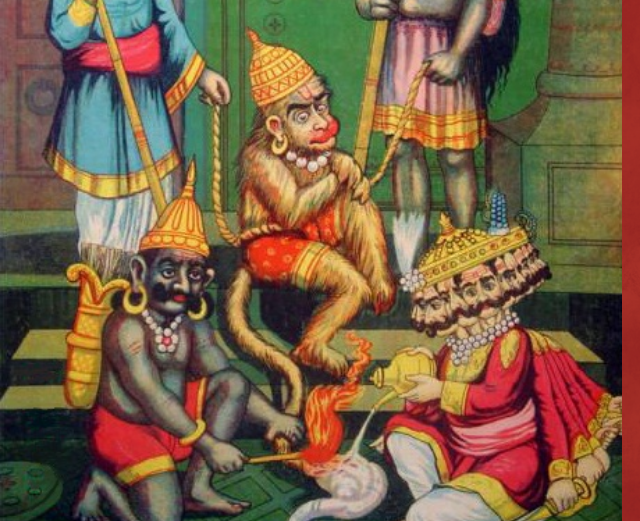
When Ravan refused to offer him a seat, Lord Hanuman coiled his long tail to sit atop it — forcing Ravan to look up at him. Enraged, Ravan ordered that Sri Hanuman’s tail be set on fire. Lord Hanuman leapt through the city, using that very fire to burn down parts of Lanka — but only as far as his mission allowed. He didn’t destroy the kingdom, though he could have. His purpose was clear: to deliver Ram’s message, not to wage war.
Throughout the story, Sri Hanuman stands as an ideal devotee — an instrument of the Divine, acting without ego or expectation of reward. The only thing he seeks is Sri Ram.
There are three important incidents from the story of Lord Hanuman that teach the example of selfless action.
The Beginning – Madhur Phal
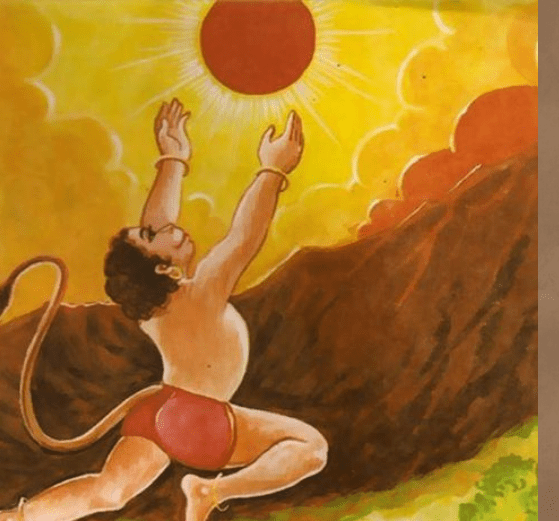
Soon after his birth, Lord Hanuman felt hungry. Looking up, he saw the red sun and mistook it for a ripe fruit. He leapt towards it, intending to eat it. The Hanuman Chalisa describes this episode:
जुग सहस्त्र जोजन पर भानू ।
लील्यो ताहि मधुर फल जानू ॥
The distant sun —
You mistook for a sweet fruit.
In his discourse, Aniruddha Bapu offers a delightful interpretation:
An ordinary child cannot see far or move much, but Sri Hanuman could see and reach for something millions of miles away. This shows not only his divine strength but also the nature of his hunger. From the very beginning, his longing was not for worldly desires (kaam), but for the eternal (Raam).
For him, Sri Ram was the Madhur Phal, the sweetest fruit. For most of us, however, Sri Ram (the Divine) feels like bitter medicine — something we turn to only in times of need, or as a means to gain what we desire. Our prayers often come from wanting more, not from wanting Him.
This story also teaches fearless faith. Aniruddha Bapu reminds us:
“When Hanuman leapt towards the Sun, he didn’t think — ‘I’m too small. What if I fall?’
If one must fall, it’s better to fall in the pursuit of Truth than for fleeting gains.”
Sat — the Truth — is the only thing that endures. It is the only thing worth dying for, and therefore, truly worth living for.
The Pearl Necklace — Moti Mala
After the battle of Lanka, when Sri Ram returned to Ayodhya, his coronation (Pattabhishekam) was celebrated with great joy. At the end of the ceremony, the gods offered gifts. Lord Indra presented a radiant pearl necklace, which Sri Ram handed to Sita Devi, asking her to gift it to whoever she felt was most deserving.
Sita Devi looked lovingly at Hanuman and offered it to him. Lord Hanuman received it respectfully — but soon, people noticed him breaking the pearls with his teeth.
Shatrughan asked, “Hanuman, what are you doing?”
Sri Hanuman replied, “I’m looking for Ram inside these pearls.”
The gathering murmured — some even mocked him for not understanding the value of jewels. Lord Hanuman said simply, “If there is no Ram in them, I have no use for them.”
Someone teased him: “If that’s so, Hanuman, does your body contain Ram?”
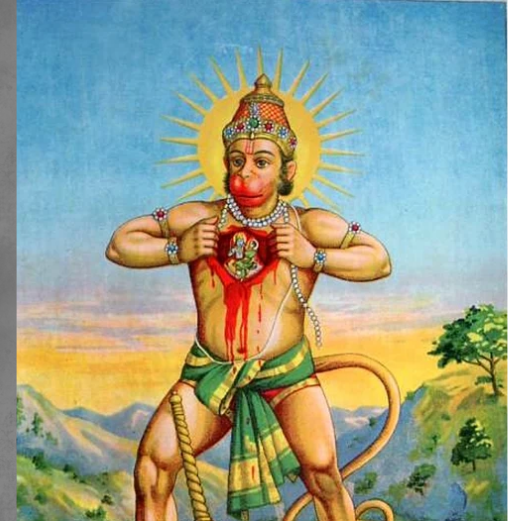
Smiling, Lord Hanuman tore open his chest — revealing Sri Ram and Sita Devi residing in his heart.
This powerful moment reminds us that devotion is not just worship of a deity outside us — it is the awakening of the Divine within.
Sri Ram was moved beyond words. He said no gift could equal Lord Hanuman’s devotion — except himself. Later, when Sri Ram departed for Vaikuntha, Sri Hanuman wished to go with him. But Sri Ram asked him to stay — to be present wherever Ram’s stories are told, to strengthen the devotion of seekers. And so Lord Hanuman became Chiranjeevi — immortal — ever ready to help us discover Ram within.
The Ramayan of Hanuman
It is believed that before Sage Valmiki, Lord Hanuman had written his own version of the Ramayana on banana leaves. When Valmiki read it, he was heartbroken — Hanuman’s version was far more sublime. “No one will ever read mine now,” lamented Valmiki.
Upon hearing this, Lord Hanuman quietly tore up his own manuscript and swallowed it.
Surprised, Valmiki asked, “Why did you do that?”
Lord Hanuman replied,

“Valmiki needs Valmiki’s Ramayana more than Hanuman needs Hanuman’s Ramayana.
You wrote the Ramayana so that the world remembers Valmiki;
I wrote the Ramayana so that I remember Ram.
I have achieved my objective — Valmiki needs to achieve his.”
This story captures the essence of nishkaam karma — doing one’s work not for fame or recognition, but as a path to rediscover the Divine within.
Reflection
Can you recall a time when you moved beyond the pull of material reward and sought deeper meaning in your effort?
How did it feel?
Sources
- Aniruddha Bapu, Ramraksha Pravachan – 5
- Devdutt Pattanaik, My Hanuman Chalisa
- Naadopaasana: Hanuman and the Pearl Necklace
Image Credits
- The Metropolitan Museum of Art, Hanuman Bearing the Mountaintop with Medicinal Herbs.
- Bazaar art, Columbia.edu, Hanuman then allows himself to be captured by Ravana, who sets his tail on fire
- Ravi Varma Press, Hanuman showing Rama and Sita within his heart
- Wikipedia Commons, Sage Valmiki composing the Ramayana
 The Sabad Project - Wisdom stories
Leave a comment