

Is there a behavior you sometimes regret — something you promised yourself you would never do, yet find yourself repeating?
We often notice behaviors in others that have hurt us and resolve never to pass that hurt forward. But in moments of stress or fear, we may catch ourselves doing exactly what once wounded us.
The story shared by Thich Nhat Hanh (fondly called Thay) offers hope. It reminds us that we can break free from inherited patterns of pain — and in doing so, protect not only ourselves, but those who come after us.
The Swiss Boy

Thay recalls an incident from Plum Village, his meditation community in France. A twelve-year-old Swiss boy and his sister often visited the center.
The boy felt unhappy with his father. Whenever he got hurt while playing, instead of helping or comforting him, his father would shout —
“Why did you do that?”
“That’s such a stupid thing to do!”
The boy longed for kindness when he was in pain, not anger. He couldn’t understand why his father behaved that way. As a child, he couldn’t change much, but he made a quiet promise to himself:
“When I grow up, if I have a son and he falls down, I’ll help him up and comfort him instead of shouting.”
The Little Sister
One day, the boy was watching his younger sister play on a hammock with a friend. Suddenly, the hammock flipped over, and both girls fell to the ground.
The boy jumped up and ran toward them. A thought flashed through his mind —
“That’s such a stupid thing to do. Who asked you to do that?”
He caught himself. The words hadn’t yet left his mouth, and he noticed some adults were already helping the girls. They were safe.

He stopped, turned back, and began walking slowly — practicing mindful walking, just as he had learned at the center.
Insights into the Mind
As he walked slowly, the boy began to think about what had just happened. Gradually, a few insights arose in his mind.

The first insight
He saw that the same energy that made his father shout was now inside him too. When he saw someone he loved in danger, he felt afraid. That fear turned into anger. The same seeds that were in his father were also in him.
The second insight
He realized that if he was not careful, he might do the same thing one day. He had to find a different way to respond, or he would repeat what he had seen others do.
The third insight
Then came a deeper understanding. His father was probably a victim too. He had suffered this behavior from someone else, and without awareness, he was passing it on.
This thought filled the boy with compassion. His anger began to fade. He decided that when he went home, he would share this insight with his father — and together, they would try to water the seeds of peace instead of the seeds of pain.
Lotus Seeds
Thay compared this to the seeds of a lotus plant.
A lotus seed does not sprout easily. It can lie in the soil for weeks, months, or even years without growing. The seed does not die. It simply waits.
Why does it not grow? The outer shell of the seed is very hard. Water cannot enter. To help it grow, one must gently cut or rub the seed so that water can reach inside.
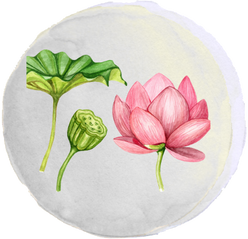
Once the seed is placed in water or soft mud, it begins to sprout. In a few days, a tiny shoot appears. When the plant receives the right sunlight and warmth, it grows, blossoms, and soon fills a pond with beautiful lotuses.
We are like that too.
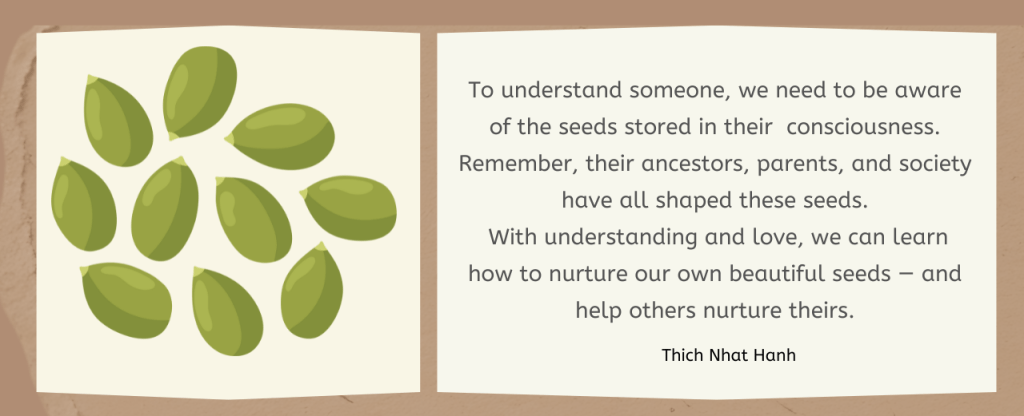
We carry many seeds inside us — seeds of kindness, patience, and joy, but also seeds of fear, anger, and pain.
Each seed can grow when the right conditions are present. The seeds we water will shape the person we become.
Insights from Modern Science
Modern science calls this neuroplasticity — the brain’s ability to change. Our minds may be shaped by genetics and environment, but they are not fixed. We can rewire them with awareness and practice.
How do we do this?
- Awareness: By pausing to reflect on our actions and the beliefs that drive them, we begin to see the patterns we unconsciously repeat.
- Alternatives: Observing others, studying, or reflecting can reveal gentler ways to respond.
- Practice: Like muscles, our habits strengthen with use. Knowing what’s right isn’t enough — we must practice it until it becomes our natural response.
- Environment: Surrounding ourselves with people and spaces that nurture our best selves helps the right seeds grow.

Breaking the Chain

The little boy’s story reminds us that awareness is the first step toward change.
When you notice a habit in yourself that makes you uncomfortable, that awareness is the beginning of transformation.
Every moment gives us a chance to break the chain — to stop passing on what causes pain and to nurture what brings peace. Like a lotus seed, when we water the qualities of kindness, patience, and understanding, they bloom — not just in us, but in the people around us.
Reflection question:
What is one reaction pattern you want to change in yourself? What qualities can you nurture in yourself to transform it?
Reference:
Thich Nhat Hanh, A Pebble for Your Pocket
 The Sabad Project - Wisdom stories
Leave a comment