

Walking the path of truth is never easy. It often means working harder, letting go of gain, and facing opposition. People may even ask: “What have you gained? Look at others who don’t care about honesty and see how far they’ve gone.”
At such times, doubt can creep in. Those who compromise on values may appear to be doing better — enjoying comforts, status, and even what seems like happiness. But for a seeker, faith in the path is essential to keep moving forward. A story from the life of Guru Nanak offers us guidance in such moments.
Guru Nanak’s Visit
During one of his travels, Guru Nanak stopped outside a village for a few days. As always, he sang hymns in praise of the Divine, accompanied by Bhai Mardana on the rebab. Word spread, and people began gathering to listen.
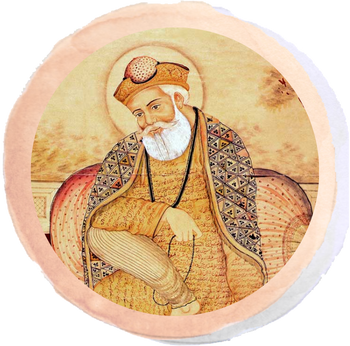
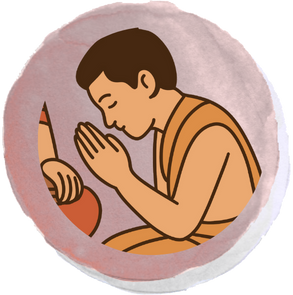
Among them was a shopkeeper — a well-to-do and pious man. Whenever he heard of religious teachers visiting, he would make it a point to offer his respects. Hearing of the Guru’s visit, he went to see him one evening. The Guru was singing hymns, accompanied by the gentle strains of the rebab. A deep calm seemed to embrace the entire place. The shopkeeper closed his eyes and was carried away in rapture. When he finally opened them, he realized that a long time had passed — so profound was the effect of the music that he hadn’t even noticed how long he had been immersed in it.
He didn’t want to return home, but with a family to care for, he left with a resolve to return the next day. This became his routine — attending to his shop in the day and making his way eagerly to the Guru’s congregation every evening.
A curious neighbor
His neighbor, noticing him head out for what seemed like important business every evening, grew curious and asked, “Where do you go after work every day?”
The shopkeeper smiled and replied, “Come with me and see. A Guru has come to our village. His hymns bring a peace to the mind unlike anything I’ve known.”
The neighbor scoffed at first, but finally agreed to accompany him. Yet at the fork in the road, temptation beckoned. Instead of turning towards the Guru’s hut, he winked and said, “Someone else waits for me.” His evenings, unknown to his family, were spent in the company of women and wine.
And so it went: each day, both men left the village together, one turning towards the Guru, the other towards indulgence.
The rewards on the path

One evening, the neighbor suggested: “Let’s return home together. We’ll meet under this tree by the fork. If you come early, wait for me, and I’ll do the same.”
That day, the neighbor finished early and sat waiting under the tree. To pass the time, he dug the soil with a twig — when suddenly something shiny caught his eye. A gold coin! Delighted, he dug further and unearthed a small pot. To his disappointment, it was filled not with treasure but with pieces of coal. Still, he kept the gold coin, feeling it a lucky windfall.
Soon after, the shopkeeper returned, limping and in pain. One foot was bandaged.
“What happened to you?” the neighbor asked.
“I stepped on a thorn. It pierced my foot, and I can barely walk.”
The neighbor laughed mockingly: “What good is your piety? You spend your evenings listening to hymns, while I enjoy myself — and today I was rewarded with gold! You go to meet your Guru and come back with a wound.”
The Question
Their lives stood in sharp contrast:
- One fixed his mind on the Divine; the other on pleasures.
- One earned honestly; the other cared only for gain.
- One shared with those in need; the other clutched whatever he could find.

The neighbor pressed his question: “What have you gained from walking this path?”
The shopkeeper replied calmly: “This question can only be answered by the Guru.”
The next day, both went to see Guru Nanak and shared their puzzlement: Why was vice rewarded while virtue suffered?
The Guru Explains
Guru Nanak explained:

“The pot you found once held a thousand gold coins. Long ago, you gave a coin to a sage. That good deed was to return to you a thousandfold. But as you turned towards misdeeds, the coins blackened, one by one, into coal — until only a single gold coin remained.”
Turning to the shopkeeper, he said:
“This man’s past deeds once earned him the noose. But through a life of honest living and devotion, their weight has lessened. What could have been death became only the prick of a thorn. His life is turning toward light, while yours is sinking deeper into darkness. Our deeds shape our habits, and our habits shape our destiny.”
The neighbor trembled. “What can I do now?”
The Guru said gently: “You still have life ahead of you. Change your path, and your life will change.”
The Wisdom of Traditions
The lesson from this incident is said to be captured in one of the verses of Gurbani, which reminds us that as long as we are driven by the pull of old habits, we remain restless. But when we turn to the Divine within, the mind finds steadiness.
The mind is the ink, and actions become paper;
Good and bad are both inscribed upon it.
As past habits drive us, so are we driven;
But the Divine’s virtues are endless —
through them, one can overcome even the weight of habit. ||1||
O foolish mind, why do you not listen to your True Self?
Forgetting the Divine, your virtues wither away. ||1||Pause||

The night is a net, and the day is a net;
Every passing moment is a snare.
With relish and delight, you bite at the bait;
You are trapped, you fool — how will you ever escape? ||2||
The body is the furnace, in which is cast the iron of the mind.
The five fires of passion heat it fiercely;
The coals of sin turn up the flames.
Tongs of worry and anxiety toss the mind,
Burning it down into slag. ||3||
But do not despair.
What has turned to slag can become gold again,
When the Guru, the Philosopher’s Stone, touches it.
He blesses with the Nectar of the One Name,
And then, O Nanak, the wandering mind finds steadiness. ||4||3||
References
- Bhai Sahib Bhai Vir Singh, Gur Balam Sakhian
- Harish Dhillon, Janamsakhis
- Dr. Gopal Singh, English Translation of Sri Guru Granth Sahib
- Sri Guru Granth Sahib, Ang 990 — Sikhitothemax.org
Reflection Question
Have you ever faced a situation where doing what was right felt hard, but eventually led to something good?

 The Sabad Project - Wisdom stories
Leave a comment