
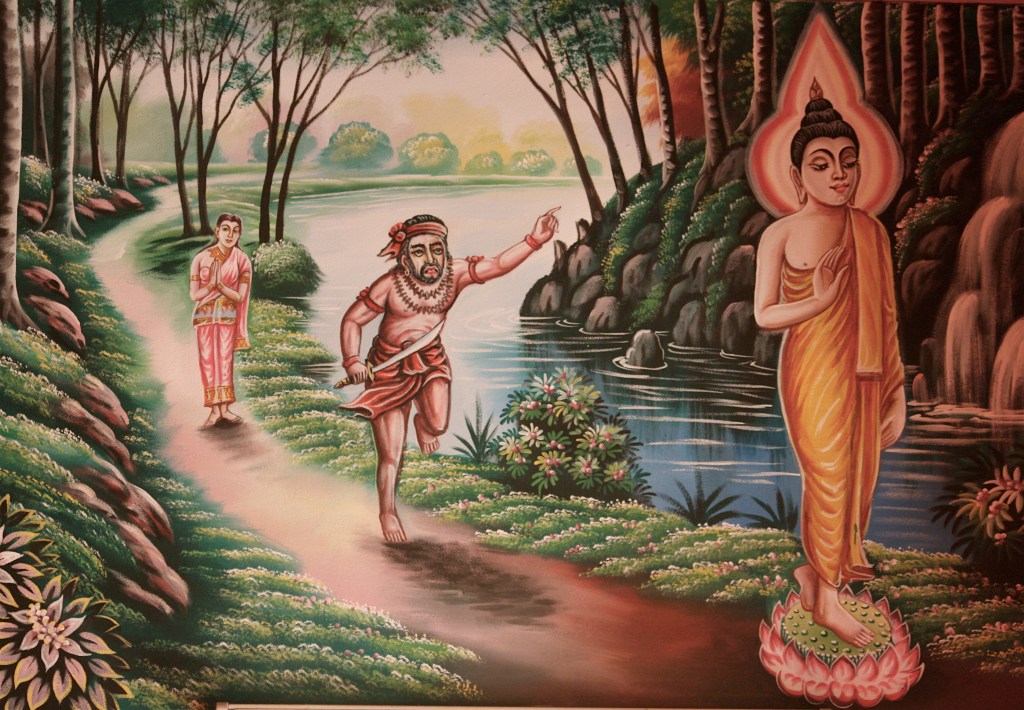
Have you heard the story of Angulimala?
Most likely yes.
But have you heard what happened after he met the Buddha?
Most likely not.
We often dwell on the flaws of others—the pain they cause, the wrongs they do. But when they change, when they transform, we rarely speak of it.
Another question that arises from the story – While we are able to believe that someone like Angulimala can change, what does it mean for our lives?
True, we don’t meet mass murderers every day. But we do meet people whose behavior causes us deep hurt. It is hard to imagine that such people can change. Perhaps it’s time we re-read the story of Angulimala, especially the parts that are often left untold.
From Ahimsaka to Angulimala
At birth, Angulimala was named Ahimsaka—the harmless one. Son of a respected official in King Pasenadi’s court, he was a bright, sincere student, later sent to study at Taxila, the great center of learning.
His brilliance made him the teacher’s favorite, but also the target of envy.
His peers started telling the teacher false stories about Ahimsaka and his scandalous character. The teacher didn’t entertain them because Ahimsaka was a very good student. But the rumor mongers persisted. The teacher finally succumbed to suspicion when they rumored that he was in fact having an illicit relationship with the teacher’s wife.
The teacher was fuming with rage. He would have wanted to kill Ahimsaka. But he couldn’t do that. So he devised a punishment that was worse – he told Ahimsaka that, in order to graduate, he must offer a gurudakshina—a thousand fingers, each taken from the right hand of a different person.
A Tough Life
Ahimsaka could not imagine killing anyone — it was against his nature. But the teacher would not relent. The weight of this cruel demand broke him. He went into the forest, his mind tormented, yet determined to complete the task.
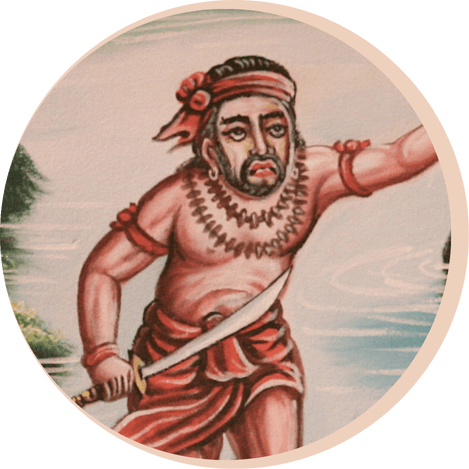
He built a hut on a cliff from where he could see travelers passing by the road below. Whenever he saw someone passing by, he would ambush and kill them. And cut a finger from their right hand. At first, he hung the fingers on a tree branch, but birds soon pecked them away. So he strung them together and wore them around his neck.
That is how Ahimsaka became known as Angulimala — the man with the garland of fingers.
Terror Spreads
Fear swept across the kingdom. Travelers avoided the road where Angulimala waited on the cliffs. When victims grew scarce, he began storming villages and towns, striking terror in their homes.
Desperate, the people went to King Pasenadi, demanding justice. Alarmed by the scale of the crimes, the king started gathering an army of 500 horsemen to hunt Angulimala down.
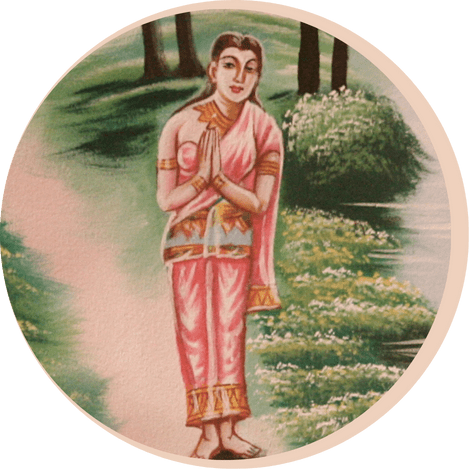
Meanwhile, Ahimsaka’s mother was in anguish. When she heard that soldiers were hunting her son, she ran into the forest to find him. Carrying a home-cooked meal, she hoped that a mother’s love might stop him. But by now, Angulimala had killed 999 people—and was waiting for his thousandth victim.
The Buddha foresaw the danger: if Angulimala saw his mother first, he would kill her and fall even deeper into sin. So he walked calmly onto the very path where Angulimala was known to strike.
People begged him not to go. “He is a brutal killer,” they warned. “He has overpowered groups of forty men at once.” But the Buddha kept walking.
From his hiding place, Angulimala saw his mother on the path—and rose to strike. But just then he noticed another figure: the Buddha, walking calmly in the other direction. He turned from his mother and ran towards him.
Encounter With The Buddha
A strange thing happened. Angulimala ran with all his might, while the Buddha seemed to be walking at a slow pace. But no matter how fast he ran, Angulimala was not able to catch up with him.
Exhausted, he cried out:
“Stop, O monk! Stop!”
The Buddha turned:
“I have stopped long ago, Angulimala. When will you stop?”
Confused, Angulimala asked, “But you are still walking—how can you say you have stopped?”
The Buddha replied:
“I have stopped harming living beings.
I have stopped ill treating all beings.
I have now established myself in universal love, patience and knowledge. But you—you have not stopped.”
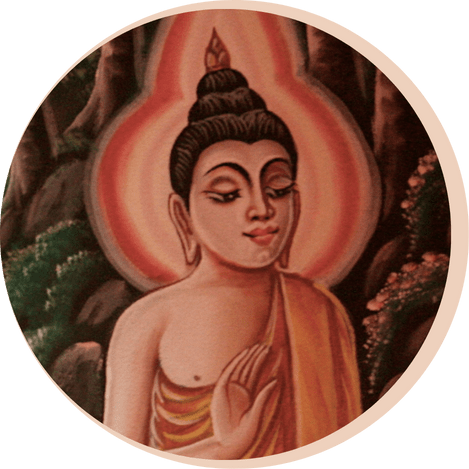
For the first time, someone faced him without fear or hate. Someone who saw beyond his crimes – and the person he truly was inside. Angulimala was overwhelmed. He collapsed at the Buddha’s feet and begged for refuge. The Buddha accepted him as a disciple.
The King’s Transformation
Angulimala took refuge in the teachings of the Buddha. He became a monk and started practicing meditation and looking within himself. Sometime later, King Pasenadi left for the forest with his army in search of Angulimala.
On the way he stopped at the monastery to pay respects to the Buddha. When the Buddha enquired where he was headed with the large army, the king told him that they were on their way to hunt down the bandit Angulimala.
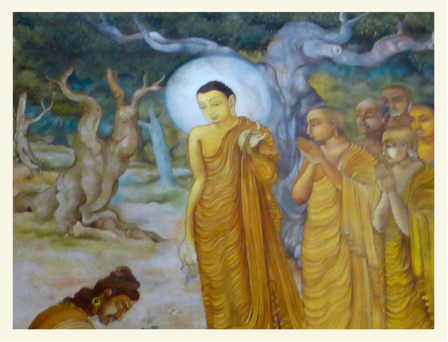
The Buddha asked the king: Suppose you were to see Angulimala with his head shaved, wearing the ochre robe, refraining from killing living beings, refraining from taking what is not given, living a life of virtue and character: what would you do to him?”
The king answered, “We would bow down to him. Offer him a seat. We would offer him food and medicine. Protect him. But how could there be such virtue in such an evil character?”
The Buddha pointed to a quiet monk sitting nearby – “That, great king, is Angulimala.”
The king was astonished. He bowed to him deeply, realizing that someone capable of great evil could also turn to great good.
From Bandit to Monk
Life as a monk was not easy. Villagers, still haunted by his past, hurled stones at him. The Buddha reminded Angulimala: the pain you suffer now is the fruit of past actions. Stay steady—the storm will pass.
One day, Angulimala came across a woman in the agony of childbirth. Her suffering pierced his heart. The Buddha guided him:
“Go to her and say, ‘Sister, since I was born into the noble life, I do not recall harming a living being. Through this truth, may you and your child be well.’”
Angulimala did as instructed. When he uttered these words before the woman, her pain eased and the child was born safely. This chant, known as the Angulimala Paritta, is still recited today, especially for the protection of women during childbirth.
Angulimala was transformed from a man who caused suffering, to a person whose heart overflowed with compassion for the suffering of others. He became an arahat— an awakened soul.
When people asked how one so steeped in evil could reach realization, the Buddha answered:
“He who overwhelms evil with good lights up the world, as the moon freed from clouds.”

What About Us?
The story of Angulimala is not only about him. It is about us—the roles we choose when we meet those whose behavior hurts us.
- The classmates spread gossip out of envy.
- The teacher, blinded by rage, demanded revenge.
- The villagers clung to hatred, unable to see the transformation in the man.
- The mother held on to love, and hoped to bring her son back from the darkness.
- The King opened his heart to transformation.
- The Buddha saw potential where no one else did—and awakened it.

Which side do we choose?
The side of aaropkar (blame, punishment, revenge)? Or the side of paropkar (compassion, patience, healing)?
Lessons for Our Relationships
- Hurt people hurt others. Most harm comes from wounds we cannot see. What they need is healing, not hate.
- People can change. Every soul is on a journey to truth. It may take lifetimes, but no one is beyond it.
- Our role matters. In the brief time we share with others, we can either pull them down with judgment, or lift them with compassion.
The Buddha’s life was pure enough that his presence alone disarmed Angulimala. We may not be Buddhas, but we can still choose our stance: to add to cycles of blame — or to break them with compassion.
We are here for only a short while, like birds resting on a tree for the night. What gives life meaning is how we help each other in that fleeting time.
References
- ICRC – A Humanitarian Re-reading of the Angulimala Sutta
- Turning Wheel – Story of Angulimala
- Vipassana Research Institute
- Vivekavani – Swami Vivekananda on Rishis
Image credit:
- Akuppa John Wigham, “The Buddha teaches Angulimala”
- Photo Dharma from Penang, Malaysia, “King Pasenadi Planting the Ananda Bodhi Tree in Jetavana”
Reflection question
Have you ever tried to see beyond someone’s flaws? How did it change your relationship or your own feelings?

 The Sabad Project - Wisdom stories
Leave a comment