
When asked to describe yourself, you might begin with details about your family, work, or education. But eventually, you’ll arrive at the values that define you — those guiding principles that shape how you think, act, and interact with the world.
These values vary from person to person. For some, honesty is the foundation of being a good human being. For others, it’s kindness, generosity, or the habit of helping others. Yet, no matter what values we hold dear, we all face the same challenge: “the other.”
“The other” refers to people who don’t share our values. The dishonest. The self-serving. The unkind. Their actions frustrate us and challenge our sense of right and wrong. Often, we get caught in a cycle of judgment, disappointment, and even anger.
A Common Dilemma
BK Sister Shivani shares a relatable scenario. Imagine you’re someone who loves helping others. One day, a friend asks for your help, and you gladly drop everything to assist them. A few days later, you need a small favor from that same person. To your surprise, they turn you down saying they are very busy.
How does this make you feel? For most of us, this would ignite a mental dialogue: “How ungrateful! I helped them when they needed it.” Worse, the next time they ask for help, you might refuse thinking, “They don’t deserve my kindness.”
Ironically, we start acting contrary to our own good nature, because we don’t see those traits in the other person. The more we allow their behavior to affect us, the more we risk losing our inherent goodness. You may have heard some people say “I was like that in my younger days – kind, honest and trusting. But I learnt the world doesn’t work like that.”
The Role of Opposites in Life
Life is built on opposites. Consider sports. A game comes alive only when two teams or players compete. If one side doesn’t give their best, the game loses its meaning.
Similarly, opposites are fundamental to creation itself. Human birth requires the union of masculine and feminine energies. The fabric you’re wearing is woven with threads running in opposite directions — the warp and the weft.
The same principle applies to good and evil. They are like two sides of the same coin, essential for the fabric of life.
The drama of life needs both the ‘hero’ and the ‘villain.’
Ram Leela: The forces of good and evil
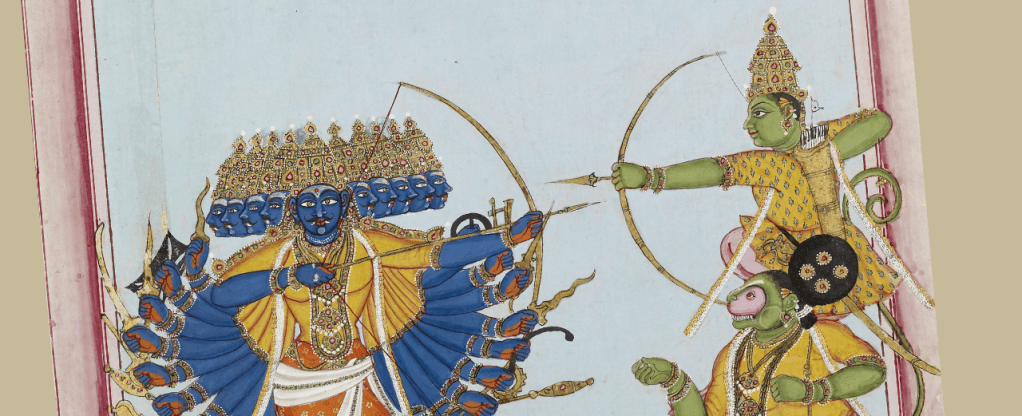
Every year, the festival of Dussehra celebrates the triumph of good over evil. The story of Rama defeating Ravana is enacted in countless towns and villages, but have you ever wondered why someone is always chosen to play Ravana? If evil is so detestable, why bother giving it a role?
This question points to a deeper truth. The drama of life needs both the ‘hero’ and the ‘villain.’ Without Ravana, there is no Ram Leela. Without darkness, light has no meaning.
Interestingly, Ravana’s character is described with grandeur. He is the king of Lanka, a city of gold. His Ashok Vatika is a lush paradise. He commands the planets and has countless sons and grandsons. In contrast, Rama lives in exile, without material wealth or splendor.
But, why glorify Ravana?
Because the greater the challenge, the greater the glory of overcoming it. Ravana’s grandeur magnifies Rama’s virtues. The brilliance of good shines brightest against the backdrop of darkness.
Seeing the Opposite as a Backdrop
Imagine trying to read white chalk on a whiteboard — it won’t work. The chalk needs the contrast of a blackboard to be visible. Similarly, stars are hidden during the day but shine against the dark night sky. Likewise, without opposition, strength of character cannot be seen.
For instance, imagine if the ‘backdrop’ of Ravana was removed from the story of Ravana and replaced with the ‘good’ force like Krishna. What would Ramayana look like? Rama would still have been sent into exile. Krishna would have received him love and respect and served Ram, Sita and Lakshmana with the deepest affection. The 14 year exile would have passed like 14 days. There would have been no struggle, no challenge. No backdrop against which the deepest virtues of Rama could be displayed. No epic of Ramayana.
Facing the opposites in life
Evil is the backdrop against which the beauty of good becomes visible. It does not mean that evil should be condoned – it helps the good play its role better.
The challenge for those striving to live virtuously is that we often feel overwhelmed by opposing forces. Sometimes, we get so caught up in resisting them that we lose sight of the larger purpose — the greater drama of life. But understanding life as a play of opposites liberates us in many ways:
- We need not fret and drain our energy dwelling over the ‘evil’ or ‘bad’ we may see around us.
- It helps us remain true to our values without getting pulled down by the opposite. Letting go of the temptation to ‘pay back evil in its own coin.’
- While doing good, remember, life is a game. The ‘good’ and ‘evil’ are players positioned by the Director on the playground of life.. Their ultimate nature, source and destination is the same ‘Divine goodness’. But in this act, they are playing their ‘roles’. The good must play its role, against the backdrop of evil. Like Rama and Ravana on the Ram Leela stage, we too have roles to play.
- If we can play our roles without ‘judging’ the other, it helps us focus on the game, not the opponent. It helps us avoid the most slippery path of virtue – the pride of being good. Because after pride comes the fall. Humility is the only vessel capable of holding infinity. This humility can be internalized better the more we learn to see life as ‘Leela’ – a Divine Drama.
Living life like the players on the stage of Ram Leela, helps us live with a lightness of being. We learn to accept opposing forces as a part of a larger scheme of Creation. It helps us ‘play’ the best actions we are capable of without judgment or resentment towards the ‘opposite.’ It reminds us to be grateful to the ‘opposite’ as it offers the backdrop to the drama of life. It pushes us to bring out goodness in us. It helps us see the light within us.
Sources:
Translated and adapted from Do Divay Ik Joti, by Giani Jaswant Singh ji Parwana.
Photo credit – Wikimedia
Reflection question
Is there a behavior or value that would upset you in the past, but have learnt to accept it better? What helped you accept the opposite better?
 The Sabad Project - Wisdom stories
Leave a comment