
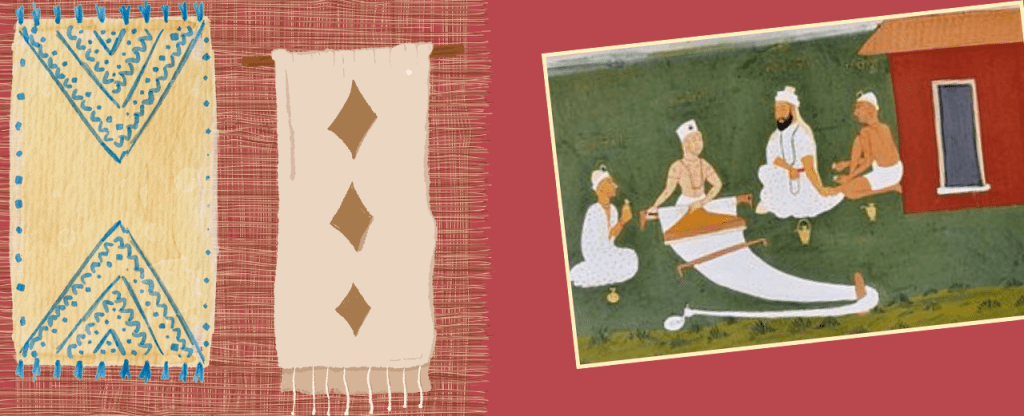
Bhagat Kabir, Bhagat Namdev, and Bhagat Trilochan were contemporary saints from the Bhakti movement. These seekers courageously challenged the rigid boundaries of caste, ritual, and formalism, carving a path to Truth that transcended these artificial constructs. In their pursuit, they often engaged in dialogues—humble, sincere inquiries to learn from one another’s spiritual insights. One such dialogue between Bhagat Trilochan and Bhagat Namdev throws some light on a dilemma many of us face today – How do we find the time to meditate in the midst of our busy lives?
A Lesson in Divine Sight
The story begins with Bhagat Trilochan spending time with Bhagat Namdev. Trilochan ji, having heard of Namdev ji’s frequent glimpses of the Divine, requests him to share the secret to these experiences.
Namdev ji obliges and sends Trilochan ji out on different occasions, assuring him that he will see the Divine. Yet, each time Trilochan ji returns, he feels disappointed. “I saw only the horseman,” he says one day. “Only the buffalo herder,” he reports another. The Divine remains elusive.
Meanwhile, Trilochan ji observes Namdev ji’s daily life. Namdev ji, a calico printer by trade, spends long hours engrossed in his work. Confused, Trilochan ji wonders why someone so spiritually elevated does not dedicate more time to prayer. One day, he confronts Namdev ji:
“Naama, you have been enticed by Maya (the material world).
Why are you busy printing fabric?
Why don’t you focus your consciousness on God?”
Naama maya moheya kahe Tilochan meet,
Kahe cheepahu chaailai Raam na lavahu cheet
Namdev ji responds with a profound teaching:
“O Trilochan, utter the Name of God with your mouth.
Let your hands and feet do all the work,
But keep your mind focused on the Divine.”
Naama kahe Tilochana, mukh te Raam samhaal,
Haath paav kar kaam sabh cheet Niranjan raakh
Let your hands and feet do all the work,
Bhagat Namdev
But keep your mind focused on the Divine
Dwelling on the Divine in the Midst of Action
This is a message echoed by many teachers. Finding the deeper meaning of life doesn’t require us to retreat from our responsibilities. The body is our vehicle to experience the world. Taking care of it, tending to it, and to our relationships is a necessary part of living life. To explain further, Bhagat Namdev offers examples from everyday life:
- A child brings paper, cuts a kite from it, and flies it in the sky. He chats with his friends, yet his attention remains fixed on the kite string.
- My mind is pierced with the name of God, says Namdev, just as the goldsmith may be talking with others, but his attention is riveted on his delicate work.
- A young girl fills her pitcher with water. She laughs, plays, and talks with her friends, but her focus is always on balancing the pitcher.
- A cow is let loose, grazing in the fields up to five miles away, but its heart remains fixed on its calf.
- Listen, Trilochan, Namdev explains, just as a mother lays her infant in a cradle, she works inside and outside the house, yet her attention never strays from her child.
Namdev ji’s wisdom reminds us that meditating on the Divine doesn’t require retreating from life. Instead, it’s about cultivating mindfulness and remembrance amid action.
The Mystery of Seeing the Divine
Returning to the question of why Trilochan ji saw only ordinary figures like the horseman, the buffalo herder, or the dog: Namdev ji’s teachings hold the key to understanding.
“In the one and in the many, He is pervading and permeating; wherever I look, there He is.
Yet, the marvelous impression of Maya is so fascinating that few understand this.
Everything is God, everything is God. Without God, there is nothing at all.
As one thread holds hundreds and thousands of beads, He is woven into His creation.”
Namdev ji teaches that the Divine is present in all of creation—like a thread connecting every bead in the necklace of life. The challenge, however, lies in seeing beyond the veil of Maya (illusion) that blinds us to this truth.
This vision, Namdev ji reminds us, is the purpose of meditation, prayer, and self-enquiry: to awaken to the realization that the One is present in all things. With this awareness, the walls of separation dissolve, our inner conflicts quieten, and we reconnect with the infinite flow of Oneness.
References
- Bhagat Kabir Ji, Guru Granth Sahib, Ang 1375
- Bhagat Namdev Ji, Guru Granth Sahib, Ang 485
- Gurmel Singh, Bhagat Trilochan Ji, Guru Nanak Dev Mission
- Dr. Amrit Kaur, Bhagat Trilochan: The Sikh Seer of Past, Present, and Future
- Namdev Ji, Punjabi Pedia
- Image Credit: Wikipedia
Reflection Question
How do you find moments to meditate amidst a busy day?
 The Sabad Project - Wisdom stories
Leave a comment