
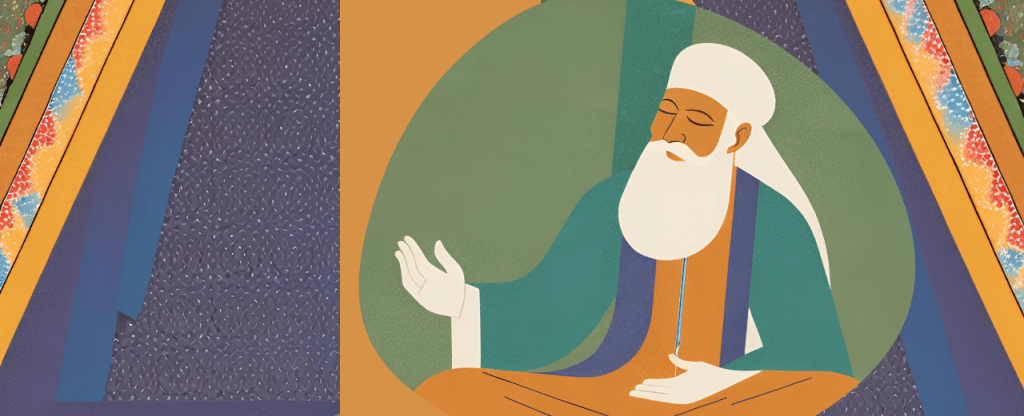
Guru Nanak spent many years spreading the message of the Oneness of all creation. He traveled far and wide—from Kashmir to Sri Lanka, and from Assam to Mecca —sharing the message of love, unity, and spirituality.
During his travels in the Arab world, Guru Nanak engaged in deep discussions with local people. He spoke about the need to understand the true essence of spiritual traditions, moving beyond superstition, discrimination, and hatred. He reminded people that the purpose of life is to do good, help others, and live a life of gratitude and contentment.
One of the people who visited Guru Nanak daily was a Sufi dervish named Baba Bahlol. Baba Bahlol was known for speaking very little. He would sit quietly in the corner during discussions, soaking in the divine energy of the kirtan and teachings. On the day Guru Nanak was leaving Baghdad, Baba Bahlol came forward, tears in his eyes. The thought of being separated from his beloved Guru was unbearable. He said:
“O Paigambar! Either stay or take me with you. I cannot bear the thought of living without you. We have bonded in love, and now you are leaving me?”
Guru Nanak placed his hand on Baba Bahlol’s head and responded:
“Bahlol, our bond is not limited by time or space. My love for you is not temporary. Though my physical form may leave, the spark that has touched your heart will remain with you for the rest of your life.”
Guru Nanak sat on a stone as he spoke these words. Baba Bahlol spent the next 60 years sitting by that stone, meditating and reflecting on his Master’s words.
The Master’s words
In 1919, Sri Ananda Acharya, an Indian mystic who lived most of his life in Norway, visited the place where Baba Bahlol sat. In his book Snow-Birds, he wrote the following poem:
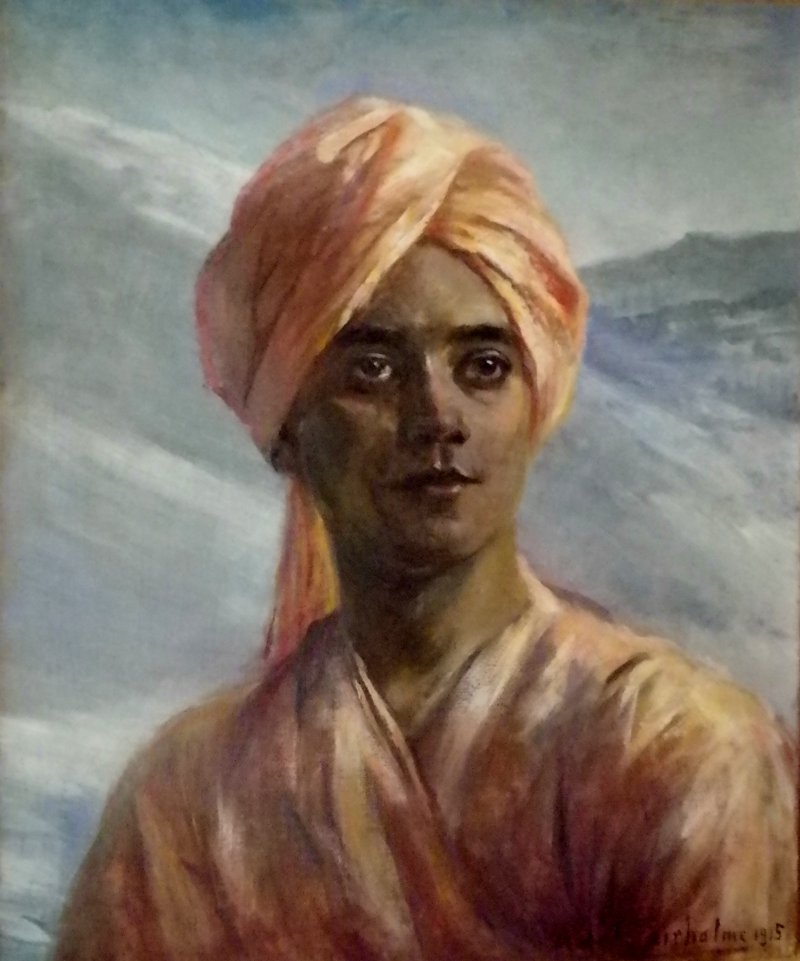
“Eight fortnights Balol hearkened to thy words on Life and the Path and Spring Eternal,
while the moon waxed and waned in the pomegranate grove beside the grassy desert of the dead.
And after thou hadst left him to return to thy beloved Bharata’s land,
the fakir, it is said, would speak to none nor listen to the voice of man or angel;
His fame spread far and wide and the Shah came to pay him homage—
but the holy man would take no earthly treasures nor hear the praise of kings and courtiers.
Thus lived he—lonely, devoted, thoughtful—for sixty winters, sitting before the stone whereon thy sacred feet had rested;
And ere he left this House of Ignorance, he wrote these words upon the stone:
Here spake the Hindu Guru Nanak to Fakir Balol, and for these sixty winters,
since the Guru left Iran, the soul of Balol has rested on the Master’s word like a bee poised on a dawn-lit honey-rose.”
“The soul of Balol has rested on the Master’s word like a bee poised on a dawn-lit honey-rose.”
Sri Ananda Acharya
The King’s visit
Baba Bahlol, known for his silence, would often sit with his eyes closed in deep meditation. But when he opened his eyes, they radiated divine love, filling even the driest of souls.
One day, the King visited Baba Bahlol. The King, wanting to offer his respects, asked:
“Baba, I have come to offer my respects. Is there something you need? I would like to give you something.”
Baba Bahlol opened his eyes and, looking at the King, replied:
“Time is precious. Don’t waste your time. And don’t waste mine either.”
The King insisted:
“I have come to offer you something. Please tell me what you need.”
Baba Bahlol responded:
“There was once a man who came here with a rebab (a traditional musical instrument). I stretched my hands out to him. He filled them so completely that thereafter, I have not stretched my hands out to ask anyone for anything.”
The Disciple’s Protest
After the King left, Baba Bahlol’s disciple asked:
“Why didn’t you ask for something? The King came to you himself. If nothing else, the roof here is crumbling. We could have asked him to fix it.”
Baba Bahlol opened his eyes and asked:
“When the King came, how was I sitting?”
The disciple replied:
“You were sitting with your legs stretched out.” Usually, people would stand up to show respect when a King visited.
Baba Bahlol continued: “Remember, son, those who stretch their hands out to ask can never sit with their legs stretched out. They must stand and bow before those who give. My Master has filled me with an inner treasure, and I no longer need anything from anyone.”
Baba Bahlol was not bound by the conventions. He had found what truly mattered in life. He had no desire for the favors of temporary kings, knowing that human existence is fleeting.
“Those who stretch their hands to ask can never sit with their legs stretched out.”
Baba Bahlol’s Teaching
This incident teaches us an important lesson – there are two ways to live life. One way is to look outside—at people, events, possessions, and validations. These things provide momentary comfort, but when they leave, they leave us wanting more. The second way, like Baba Bahlol’s, is to look within – wherein there lies a treasure: faith in the Divine.
In the power that gives rise to all life and nurtures every being. The presence that seekers have described as the “unshakeable, infallible, indescribable”.
The scheme that we may fail to understand, but never fails us.
The only support that gives true security, that lasts beyond every summer, every spring. Surrendering to which makes life truly fearless and carefree.
Finding that anchor within, removes the need for any support outside. This inner journey is long and difficult, but lives like Baba Bahlol remind us to keep going.
References
- Discourse by Giani Pinderpal Singh ‘Dukh Bande Nu Badal Denda Hai’
- Sri Ananda Acharya, Snowbirds, MacMillan
- Sant Syed Prithipal Singh, Taajudin’s Diary
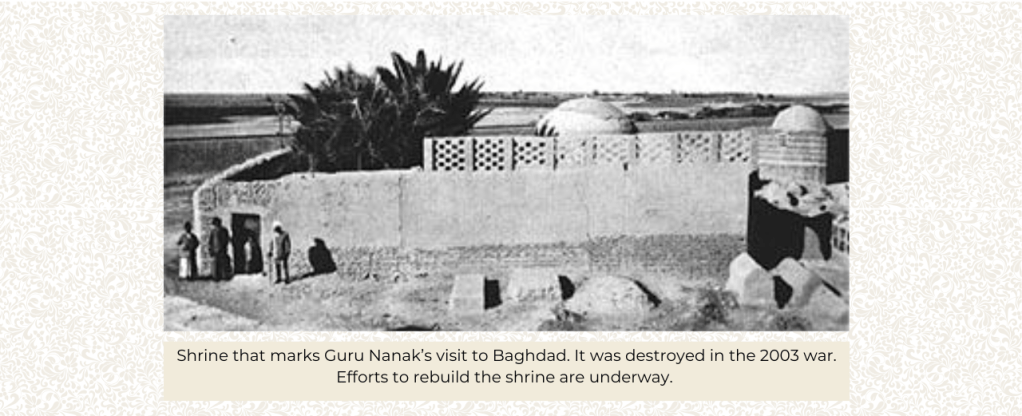
- Image credit: Sikh wiki – Guru Nanak’s Shrine in Baghdad
Reflection Question
Is there a story from your own life—or from someone you know—that reflects the power of faith in times of uncertainty? How does that story help you stay anchored when faced with challenges?


 The Sabad Project - Wisdom stories
Leave a comment