
What kind of a city do you live in? Would your friends describe it the same way?
It’s not unusual for the same city to be described in completely different ways:
“Full of action”
“Paradise on earth”
“Too polluted to breathe”
“A place where no one can be trusted“
Life is like that. The same place, the same situation, can feel completely different depending on the person experiencing it.
Bhagat Ravidas Ji’s account of the place he lives in gives us some startling insights into what it really takes to be happy — and where true joy begins.
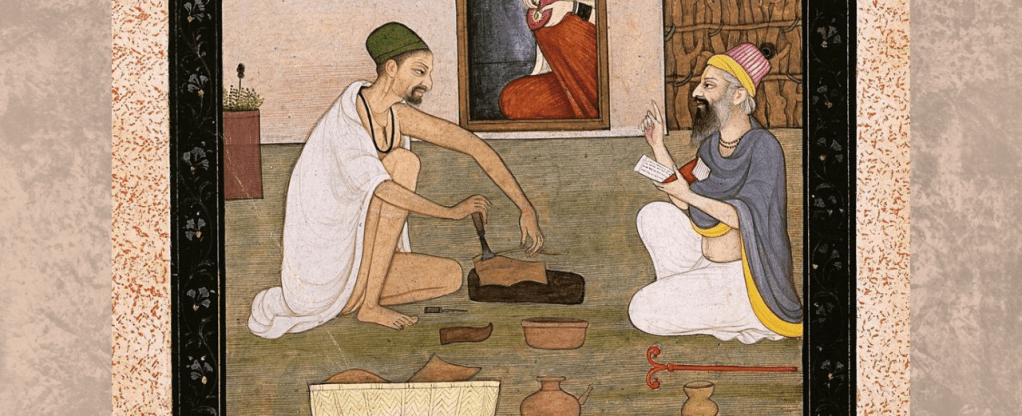
Ravidas Ji was a cobbler by profession, considered “low caste” in his time. Yet, through deep devotion, he rose to become a saint revered across traditions. Someone once asked Bhagat Ravidas ji, “What kind of city do you live in?”
Bhagat Ravidas replied:
Begumpura is the name of the town.
A place with no suffering, nor even a frown
No troubles, no taxes on trade
No fear, no faults, no loss to be weighed
Now, I have found this wondrous land
Where there is always peace and calm, my friend. ||1||Pause||
Steady and stable is this eternal Kingdom.
There is no second or third; all walk as one.
That city is populous and eternally famous.
Wealthy and content are its dwellers ||2||
They stroll about without a care.
Insiders of the Palace, to block them no one would dare.
Ravidas, the cobbler, was emancipated in this land
Whoever resides here, is also my friend. ||3||2||
– Bhagat Ravidas Ji, Sri Guru Granth Sahib Ji, Ang 345
Where Is This City?
Begumpura literally means “the city without sorrow.”
Given the circumstances he lived in — a cobbler in a rigid caste-based society, working in a trade where making ends meet was hard — this description was certainly not of the world outside.
He wasn’t describing a town or a utopia to be built someday.
He was describing the state of his mind.
Through deep devotion, Ravidas Ji tuned his consciousness to the Divine within. In doing so, he formed a personal relationship with his Master — becoming an “insider of the Palace.” He tapped into the source of all power: the universal consciousness that lives within each of us. In that alignment, he discovered the strength of virtue and was unfazed by evil.
So the world he saw was radically different from the one most others experienced.
As the saying goes:
Jaisi drishti, waisi srishti
As is your vision, so is your world.
It’s like this:
A thief sees other thieves, the anxiety of hiding stolen goods, and the fear of the police.
A saint sees other saints, the power of goodness, and the carefree detachment that comes with inner freedom.
Same world. Different sight.
How Can a World Exist That Only Some Can See?
Think of a mountain view. From the valley, we may only see narrow paths and dense trees. But from the mountaintop, a breathtaking landscape unfolds. The higher the elevation, the clearer the view.
When the mind is free from ego and blemish, it begins to see itself as a ray of the Creator’s light. It sees that same light in all beings.
It becomes abundant with the wealth of self-understanding. Wherever it turns, it connects effortlessly with the Master within — and an expression of the same in the world around.
But Is the Mind Really That Powerful?
Let’s pause and ask: What is the mind?
It is the seat of our thoughts, desires, memories, and the power to discriminate. It is a bridge between the soul and the sense organs. From the information it receives through the senses, it makes sense of the world around us. It can act like a servant to the senses — becoming happy when it finds the object of its chase, and suffering when those objects disappear. Or, it can turn inward and become the servant of the soul — reflecting wisdom, peace, and purpose.
The Sikh scriptures describe the mind as both:
Man jogi man bhogiya man moorakh gaawaar
The mind is a Yogi. The mind is a pleasure-seeker. The mind can also be ignorant.
Man daata man mangta man sir gur kartaar
The mind can be a giver. The mind can be a beggar. The mind in fact, is the True Guru, the Creator.
– Sri Guru Granth Sahib Ji, Ang 1330
This means the mind is neither good nor bad — it becomes what it connects to. A mind that frees itself from trishna — the burning craving for worldly pleasures — and turns inward through remembrance, begins to return to its source.
There it becomes pure consciousness. It rediscovers its true nature – and the infinite powers that arise from that knowing.
Man tu jot saroop hai || Apna mool pachaan ||
O mind, you are the embodiment of Divine Light — recognize your origin.
– Sri Guru Granth Sahib, Ang 440
The Goal: Becoming a Resident of Begumpura
By understanding and practicing wisdom, we too can become residents of this city within. A world of joy, freedom, and inner royalty — right here, within this world.
And none of this requires abandoning our worldly duties. In fact, it makes us better at fulfilling them.
Why? Because actions driven by ego blind our sight and sap our energies.
But just like an appliance functions best when connected to a steady power source — so too does the human mind function best when connected to its Source.
Reflection question
Can you think of one way you can focus on the Begumpura within, even when the world outside feels far from perfect?
References
- Raghbir Singh Bir, Chardi Kala
- Bhagat Ravidas ji, Sri Guru Granth Sahib
- Image credit: Wikimedia
 The Sabad Project - Wisdom stories
Leave a comment